Most people wondering how to monetize a directory website think the answer is "charge for listings." That's one way. But it's not the only way – and it's rarely the most profitable one.
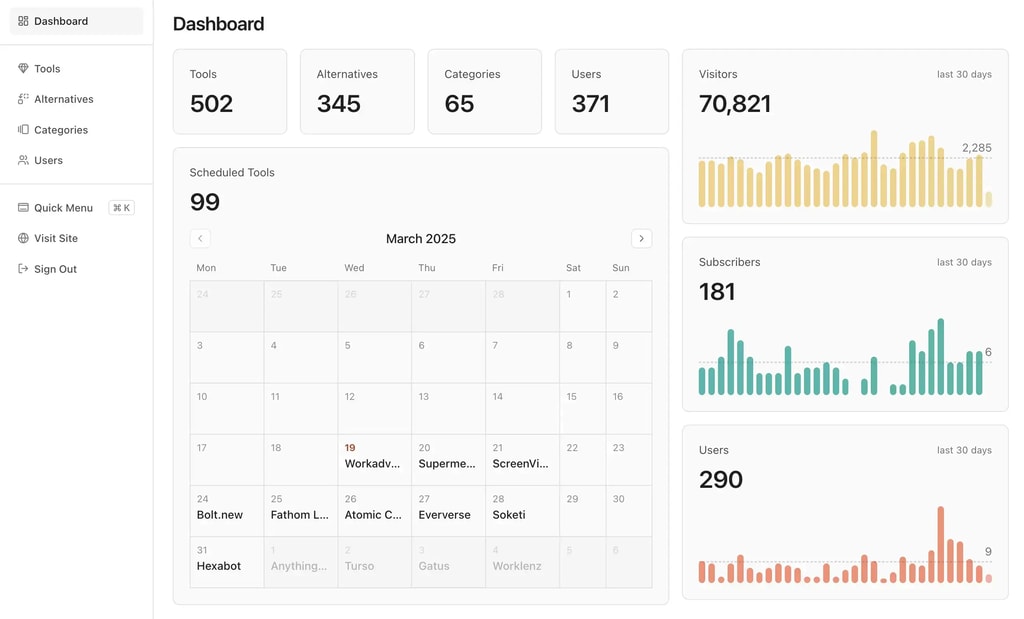
I run OpenAlternative, a directory of open source software alternatives. It generates roughly $6,500 per month – about $80,000 a year – and I spend maybe 2-3 hours a week on it. That's not a typo.
The reason directories work so well as a business is they don't rely on a single revenue stream. You stack multiple models on top of each other, and they compound. Every new listing is a new page of SEO content. More pages mean more traffic. More traffic means more revenue from every monetization channel simultaneously.
When most people think about directory monetization they immediately jump to "I'll charge for listings." That works, sure. But it's just one of five proven models I've seen generate real income. Here are all five, with actual numbers from directories I've built and studied. For the full backstory on how OpenAlternative reached these numbers, read the case study.
Paid listings

The most straightforward model. Businesses pay you a fee to get listed in your directory. Simple concept, but the execution matters.
The pricing strategy that works best is freemium. You offer a free tier to attract submissions and build your content base, then charge for premium placement or additional features. This is how most profitable directories operate – they don't gate basic listings behind a paywall.
Typical pricing ranges from $29 to $299 depending on your niche. A directory of local restaurants can charge less than a directory of enterprise SaaS products. The value to the listed business dictates what you can charge.
In Dirstarter, I built three listing tiers directly into the template:
- Free – Standard listing, appears in the directory normally
- Expedited – One-time payment to skip the review queue and get listed faster
- Featured – Recurring monthly subscription for premium placement
The expedited tier is a clever one. Businesses that just launched something want visibility now, not next week. Charging a small fee for priority review is easy money that doesn't feel extractive.
Here's some quick math. Say you launch a directory and get 200 free submissions in your first few months. If just 5% convert to a paid tier at $29, that's 10 paying customers and $290 in revenue. Not life-changing, but remember – this is just one of five revenue streams.
Pro tip: Don't charge for listings on day one. Start free, build up content, get some organic traffic flowing. Once you have 100+ listings and steady visitors, introduce paid tiers. People will pay because your directory already has value.
Featured and premium listings
This sounds like paid listings, but there's a key difference: recurring revenue.
With basic paid listings, someone pays once and they're done. Featured listings are a monthly subscription. The business pays $49 to $199 per month to get premium placement – think homepage spotlight, top of category pages, boosted visibility in search results.
This is where things get interesting financially.
On OpenAlternative, featured listings are priced at $197 per month and they account for about 35% of total revenue. That's roughly $2,275 per month from featured listings alone. The beauty is that once a business sees results from premium placement, they rarely cancel. The ROI is obvious to them – they're getting qualified traffic from a high-authority site in their niche.
What makes featured listings work:
- Homepage visibility – Featured tools appear prominently on the most trafficked page
- Category dominance – Premium listings show up first in their categories
- Visual distinction – Badges or highlights that make listings stand out
- Analytics access – Some directories offer click/view stats for premium members
In Dirstarter, featured listings are handled through Stripe subscriptions. When a business subscribes, their listing automatically gets featured status. When they cancel or their payment fails, the webhook removes the featured flag. Zero manual work.
The recurring nature is what makes this model so attractive. Ten businesses paying $197/month is nearly $2,000 in MRR. Twenty businesses gets you close to $4,000. And because featured placement delivers measurable value, churn stays low.
Advertising and sponsorships

This is OpenAlternative's biggest revenue driver. Ads and sponsorships make up about 65% of the $6,500 monthly revenue – roughly $4,225 per month.
There are two types of directory ads that work well:
- Listing ads – These appear within the directory content itself. On the homepage, between listings, or on individual listing pages. They blend in with the content and get strong click-through rates.
- Banner ads – These sit at the top of every page. More visible, more traditional, and typically priced higher.
Pricing depends entirely on your traffic. A directory pulling in 70,000 monthly unique visitors (like OpenAlternative, which also sees 275,000 pageviews) can charge $150 to $500 per ad slot per month. Smaller directories with 10,000 visitors might charge $50 to $150.
The key to advertiser retention is traffic quality. Directory visitors are typically high-intent – they're actively looking for solutions in your niche. That makes your ad inventory more valuable than generic display ads. Advertisers who see real conversions from your traffic will keep renewing.
Selling those slots directly — setting prices, letting advertisers book date ranges, and tracking impressions — is exactly what an ad management tool like Revinel automates.
Dirstarter wires this straight into Revinel, so you get the whole system without building or maintaining it:
- Listing ads and banner ads – Both placements, served and rotated automatically
- Hosted pricing and checkout – Advertisers pick a tier and pay on your
/advertisepage - Impression and click tracking – Routed through your own domain, so ad blockers can't drop it
- Direct payouts – Advertisers pay you through Stripe; Revinel handles serving and billing
Pro tip: Don't slap ads on your directory before you have real traffic. Premature advertising kills trust. Your first 1,000 visitors need to see a clean, useful directory – not a billboard. Wait until you're consistently getting 10,000+ monthly visitors before introducing ad placements.
Affiliate marketing

This is the lowest-effort revenue model, and you can start it from day one.
The concept: add affiliate links to your directory listings. When someone clicks through and makes a purchase, you earn a commission. No extra products to create, no sales calls, no invoicing.
This works especially well for SaaS directories. Most SaaS products have affiliate programs with generous terms – typically 20-30% recurring commissions or $50 to $200 one-time payouts. Some programs like Shopify's pay even more.
Let me run some numbers. Say you have a directory with 500 SaaS tools, each with an affiliate link. Your directory gets 50,000 monthly visitors with a 1% click-through rate on affiliate links. That's 500 clicks per month. If even 2% of those convert at an average $5 commission, you're looking at $50/month. Not huge – but that scales. Bump your traffic to 200,000 visitors and suddenly it's $200/month on complete autopilot.
The real wins come from high-ticket affiliate programs. A single enterprise SaaS conversion paying $200 commission can happen any random Tuesday.
In Dirstarter, affiliate link support is built right into listings. Just paste the affiliate URL and it gets used as the primary outbound link. No plugins, no workarounds.
Pro tip: Use a link shortener like Dub for tracking. It lets you see which listings drive the most affiliate clicks so you can optimize placement and double down on what works.
Sponsorships and partnerships
Sponsorships sit a tier above standard advertising. They're higher-value deals that go beyond a simple banner placement.
The types that work for directories:
- Newsletter sponsorships – If you build an email list around your directory's niche, sponsors will pay to be featured in your sends
- Category sponsorships – A company "owns" an entire category page. Every visitor browsing that category sees their branding
- Homepage takeovers – The premium option. One sponsor gets dominant placement across the entire homepage for a set period
- Content partnerships – Sponsored reviews, comparisons, or guides that tie into your directory's content
These deals typically range from $500 to $5,000+ per month depending on your traffic and niche authority. They require more relationship-building than self-serve ads, but the revenue per deal is substantially higher.
On OpenAlternative, sponsorships are bundled into the ads/sponsorships category that makes up 65% of revenue. Some sponsors book multiple months in advance because the traffic quality is consistently strong.
How to land sponsors: Approach companies already listed in your directory. Show them your analytics – monthly visitors, pageviews, audience demographics, and the organic search terms driving traffic. If you can demonstrate that your audience matches their target customer, the conversation is easy.
You don't need massive traffic to attract sponsors. A directory with 5,000 highly-targeted monthly visitors in a specific B2B niche can command higher sponsorship rates than a generic site with 50,000 visitors. Relevance beats volume every time.
The revenue stack: combining all five models

Each of these models works on its own. But the real power comes from stacking them together.
OpenAlternative runs on ads, sponsorships, and featured listings simultaneously. That combination produces $6,500 per month from a site I maintain in a few hours per week. And it's not an outlier among successful directories:
| Directory | Annual Revenue | Primary Models |
|---|---|---|
| Nomad List | ~$360,000 | Memberships, ads, job listings |
| SaaS Hub | ~$120,000 | Featured listings, ads, affiliates |
| OpenAlternative | ~$80,000 | Ads/sponsorships, featured listings |
The compounding effect is what makes directories special. Every listing you add is a page of SEO content. Each page ranks for long-tail keywords and pulls in organic traffic. That traffic feeds every revenue stream at once – more eyeballs for ads, more potential customers for featured listings, more clicks on affiliate links, more leverage when negotiating sponsorships.
Say you have 500 listings and each one brings in an average of 100 organic visitors per month. That's 50,000 monthly visitors. Now apply all five revenue models to that traffic:
- Paid listings from new submissions
- 15-20 featured listings at $197/month
- 4-6 ad slots generating $200-400/month each
- Affiliate commissions trickling in across hundreds of links
- One or two sponsor deals per quarter
The revenue stacks. Every model reinforces the others. And because directories are content machines that keep growing, the numbers only go up over time.
When to start monetizing
This is where most people mess up. They launch a directory with 12 listings and immediately turn on paid features. Then they wonder why nobody's paying.
I've seen directory launches get destroyed on Reddit because the founder gated everything behind a paywall before providing any free value. The community called it a cash grab and the project never recovered.
Here's the timeline I recommend:
- Month 1-3: Free listings only. Focus on getting 100+ quality listings and building organic traffic. Make the directory genuinely useful.
- Month 3-4: Introduce paid and featured listing tiers. You now have enough content and traffic to justify premium placement.
- Month 4-6: Add advertising once you're consistently hitting 10,000+ monthly visitors. Start with one or two placements, not a dozen.
- Month 6+: Pursue sponsorships once you can show advertisers real traffic data and conversion metrics.
The one exception: affiliate links. These can go in from day one because they don't change the user experience. Visitors don't notice or care that your outbound links are affiliate URLs. It's invisible monetization that starts earning from your very first visitor.
Revenue comes when you're patient and authentic about it. Build something useful first. The money follows.
Start with all five models built in
If you're planning to launch a directory, you don't need to build these revenue systems from scratch. Dirstarter ships with all five monetization models out of the box – paid listing tiers, featured listings with Stripe subscriptions, an ad management system with scheduling and bulk discounts, affiliate link support, and the traffic foundation you need to attract sponsors.
I built it because after launching OpenAlternative, I kept getting asked how to replicate the setup. Now you can get started with a complete directory template that includes the same revenue infrastructure – and spend your time on the part that actually matters: curating great content and growing traffic.
Check out the showcase to see directories already running on Dirstarter and generating revenue with these exact models.