An online directory business is a website that organizes listings around one specific niche (tools, services, places, people) and makes money from the businesses and visitors who use it. Think of it as a curated answer to the question "what are the best options for X?", monetized through featured listings, ads, sponsorships, and affiliate links.
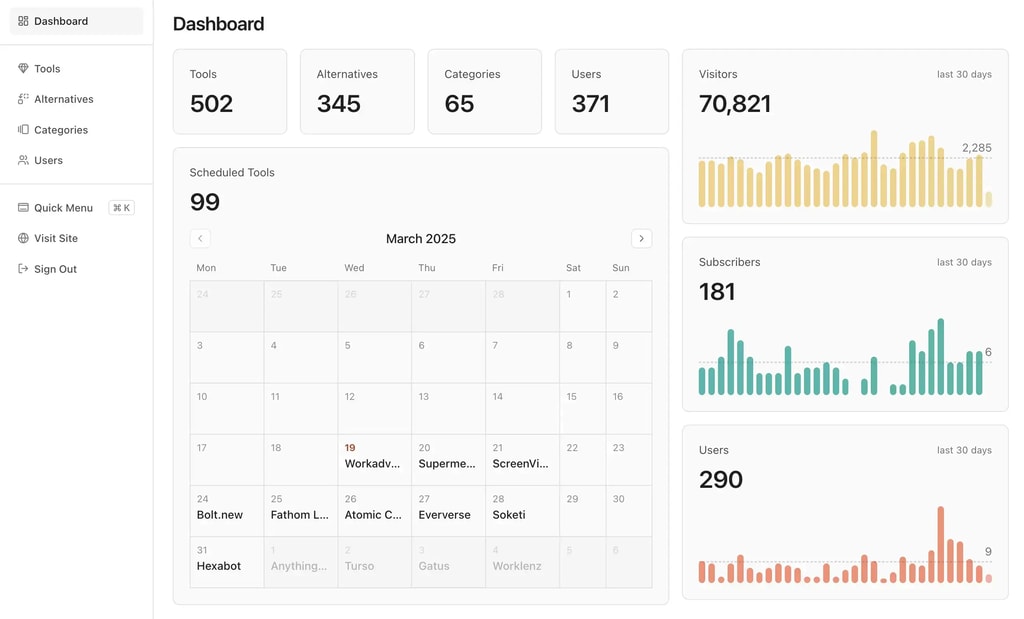
I run one. It's called OpenAlternative, a directory of open source software alternatives, and it makes around $6,500/month while taking 2-3 hours a week to maintain. I built the first version in 48 hours.
This guide covers exactly how to start one in 2026: picking a niche, validating demand, building the site, seeding listings, getting traffic, and turning on revenue. It's written for indie hackers, solo founders, and marketers who want a side business that compounds instead of one that resets to zero every month.
No theory. Just the playbook I'd follow if I were starting from scratch today.
Why directory websites still work in 2026
Every time I mention directory revenue numbers, someone tells me directories are dead. The numbers disagree. Nomad List does around $360,000/year. SaaS Hub does around $120,000/year. My own site does about $80,000/year, and I've broken down exactly where that money comes from in the OpenAlternative case study.
Four reasons this model keeps working:
- Directories are SEO compounding machines. Every listing you add is a new page, and every page is a shot at ranking for a long-tail search. Add 200 listings and you've built 200 entry points into your site. A blog post decays; a well-maintained directory keeps climbing.
- Maintenance is genuinely low. Once the structure exists, your job is curation, not creation. That's how I got OpenAlternative down to a few hours a week while it serves 70,000 monthly visitors.
- Revenue streams stack. A blog usually has one income source. A directory can run featured listings, ads, sponsorships, and affiliate links at the same time, on the same traffic. When one dips, the others hold.
- AI made curation dramatically faster. The boring parts (researching listings, writing descriptions, categorizing entries) are exactly what AI tooling is good at. The work that used to take months of data entry now takes days, and your judgment about what belongs in the directory is the part that still matters.
The barrier to entry has never been lower, but most people still build directories wrong: no niche, no validation, monetization on day one. The rest of this guide walks through the six steps that actually work, in order.
Step 1: Pick a niche where businesses pay for visibility
Most directory businesses die at this step, before a single line of code gets written. The mistake is picking a niche you find interesting instead of a niche where someone has a budget.
A directory makes money when businesses pay to be seen by your audience. So work backwards from that. Four things I look for:
- Commercial intent: visitors should be actively choosing something to buy or sign up for, not just browsing for fun
- Plenty to list: you need enough tools, services, or businesses to build a genuinely useful resource
- Search demand: people already Googling "best X for Y" type queries means traffic is waiting for you
- Advertisers with budgets: companies in the niche should already be spending money to reach these buyers
B2B and SaaS niches monetize best. A featured listing that costs $197/month is a rounding error for a software company whose customers are worth thousands in lifetime value. That exact price point drives about 35% of OpenAlternative's revenue. Try charging a local bakery $197/month and see how that conversation goes.
That said, consumer niches can work if the audience is obsessive enough. Nomad List serves remote workers, SaaS Hub catalogs software. Different audiences, same model: people choosing between options, and businesses paying to win that choice.
If you're stuck on what to pick, I put together 50 profitable directory niche ideas with notes on why each one works.
Step 2: Validate demand before you build anything
You can validate a directory niche in a weekend. Here's the workflow I use.
Start with the Google test. Search "best [niche] tools" or "top [niche] alternatives" and study page one. If you see thin listicles, outdated roundups, or no dedicated directory at all, that's your opening. If a polished, actively maintained directory already owns the results, move on or find a sharper angle within the niche.
Check the numbers with a keyword tool. Keywords Everywhere or Google Keyword Planner will do. You want two signals: search volume (people are looking) and CPC (advertisers are paying). For example, "online directory business" gets 2,900 searches/month at a $5.00 CPC. That CPC matters more than volume. It means companies are paying Google $5 every time someone clicks an ad for that term, which tells you there's real advertiser money in the space.
Confirm businesses already advertise. Look for sponsored listicles, Google ads, newsletter sponsorships, podcast spots. Businesses already advertising in the niche have proven their willingness to pay. You're not creating a budget, you're redirecting one.
Lurk in the niche's communities. Spend a few evenings in the relevant subreddits, Discord servers, and Facebook groups. If people repeatedly ask "what's the best X for Y?", you've found demand a directory answers perfectly.
Pro tip: Save screenshots of those community questions. They become your launch posts later, because you'll know exactly which threads to answer with your directory.
Before you build, run this go/no-go checklist:
- Enough inventory: you can name 50+ things worth listing without straining
- Active search demand: people are searching "best [niche]" queries every month
- Weak competition: no dominant, well-maintained directory on page one
- Proven budgets: businesses in the niche already pay for ads or sponsorships
- Reachable audience: communities exist where you can promote without buying ads
If you can tick four or five of these, build it. Two or fewer, pick a different niche and run the checklist again.
Step 3: Choose how you'll build it
Your niche checks out. The next decision is how to build the site, and it matters more than most people think. It determines your upfront cost, how fast you launch, and whether your site can actually handle 10,000+ pages when SEO kicks in.
You have four realistic options.
Directory boilerplates
A boilerplate is pre-built directory code you buy once, customize, and own forever. You get listings, search, payments, and an admin panel out of the box, then you ship in days instead of months.
This is the route I'm obviously biased toward, because I built Dirstarter after launching OpenAlternative and realizing most of a directory is the same plumbing every time. It's a one-time ~$149, you host on Vercel's free tier, and the code is yours to modify without limits.
I wrote a full comparison of directory boilerplates if you want to evaluate the options, and a step-by-step build walkthrough for when you're ready.
WordPress themes and plugins
The classic route. It's cheap to start and the plugin ecosystem covers almost everything: directory themes, payment plugins, SEO tools.
The pain shows up later. Plugin conflicts, security patches, and a database that gets slow once you're serving thousands of listing pages. WordPress directories work, but maintenance becomes your part-time job right when you should be focused on growth.
No-code builders
Tools like Softr and Webflow give you the fastest possible start. No code, visual editing, live in a weekend.
The tradeoffs: you pay $29-99/month forever, you never own the code, and you hit ceilings on both customization and SEO. Programmatic pages, custom schema markup, and fine-grained performance tuning are exactly what directories need at scale, and exactly where no-code tools box you in.
Building from scratch
Full control, zero compromises. Also the expensive route: $5,000-15,000 to hire a developer, or months of your own dev time rebuilding search, payments, submissions, and admin tooling that already exist elsewhere.
I'd only go this way if your directory has genuinely unusual requirements. For most directory ideas, you're paying a premium to reinvent plumbing.
How the options compare
| Option | Upfront cost | Time to launch | Ongoing cost | Code ownership | Scales with SEO |
|---|---|---|---|---|---|
| Boilerplate | ~$149 one-time | Days | Hosting only (free tier works) | Full | Yes |
| WordPress | Low (theme + hosting) | Weeks | Hosting + plugin renewals + maintenance | Partial | Struggles at scale |
| No-code | Free to start | Days | $29-99/month forever | None | Hits a ceiling |
| From scratch | $5,000-15,000 (or months of time) | Months | Your time or a developer's | Full | Yes, if built well |
Pro tip: Whatever you choose, optimize for time to launch. Your real risk isn't picking imperfect tech, it's spending three months building before you've validated that anyone wants the directory. You can always migrate a winner. You can't get back time sunk into a loser.
Step 4: Seed your first 100 listings
Here's the uncomfortable truth: nobody submits to an empty directory. If a visitor lands on your site and sees a handful of listings, they bounce and never come back. You need to do the seeding work yourself before anyone shows up.
My benchmark is 100+ quality listings before you launch. That's the threshold where a directory starts feeling like a real resource instead of a side project somebody abandoned. It's also roughly what you should aim for in your first 1-3 months while everything is still free.
Where do you find them? Three sources, in order of quality:
- Manual curation: Go through the niche yourself. Slow, but every listing is real and relevant. This is what I did for OpenAlternative, and it's why the early site felt trustworthy.
- Public datasets: GitHub lists, government registries, open APIs. Great starting points, but treat them as raw material, not finished listings.
- The niche's communities: Subreddits, Discord servers, newsletters. People constantly recommend tools and services there. That's free, pre-validated curation.
Resist the urge to scrape 5,000 listings and call it done. A thin scraped page ranks for nothing and helps no one. Enrich every listing instead: a proper description in your own words, screenshots, accurate categories and tags, and ideally pros and cons. Your listing page has to be genuinely better than what someone finds by Googling the tool directly.
AI makes this dramatically faster. You can generate first-draft descriptions and categorizations in bulk, then review each one by hand. The AI does the typing, you do the judgment. Skip the human review and you'll publish embarrassing errors that kill trust.
Pro tip: Enrich your best 20-30 listings first and make them exceptional. Those become your template, and they're usually the pages that rank first.
Step 5: Launch and earn your first traffic
With 100 quality listings live, you're ready to launch. And directories have a built-in distribution advantage most websites don't: every page is a landing page. Your category pages target searches like "best X tools" and each listing page targets the tool's own name. SEO is the long game here, and it compounds. The vast majority of OpenAlternative's traffic comes from search.
The mechanism behind that is programmatic SEO. One template multiplied across categories, use cases, or locations creates hundreds of pages, each catching its own long-tail search. You don't write 300 articles. You structure good data once, and the pages generate themselves. I break down how this played out in the OpenAlternative case study.
But SEO takes months, so you need launch channels for day one:
- Product Hunt: Directories do well there because they're instantly useful. No signup wall, immediate value.
- Reddit and niche communities: Share it where your audience already hangs out. Lead with the resource, not the pitch.
- Tell every listed business they're featured: This is the most underrated channel. You listed them for free, so they're flattered, and many will share the link or add a badge. That's free distribution and free backlinks from 100 relevant sites.
One more thing: start collecting emails from day one. A simple "get new listings weekly" box is enough. Search traffic visits once. An email list comes back, and it's the asset that makes sponsorships sellable later.
Step 6: Turn on monetization (in the right order)
There are five revenue models for a directory. I break them all down in my directory revenue models guide, but here's the short version with real economics:
- Paid listings: a one-time fee to skip the review queue. Easy first dollar, zero ongoing work.
- Featured listings: recurring placements, typically $49-199/month. The most reliable income a directory has, because businesses that see results rarely cancel.
- Ads: at 10,000 monthly visitors, expect $50-150 per slot per month. At 70,000 visitors, that climbs to $150-500 per slot.
- Affiliates: SaaS programs typically pay 20-30% recurring or $50-200 one-time per referral.
- Sponsorships: the big-ticket item, $500-5,000+/month per deal once you have real authority in the niche.
The ordering rule matters more than the models themselves: free first, monetize after traffic. A directory with 30 listings and a paywall is dead on arrival. Build the asset, then charge for visibility within it.
The one exception is affiliate links. They cost your users nothing and require no audience to set up, so add them from day one.
If you're using Dirstarter, the tier structure is already built in: Free, Expedited (one-time fee to skip review), and Featured (recurring via Stripe). Turning on monetization is flipping a config, not a development project.
Pro tip: When you launch paid tiers, email everyone who already has a free listing. They've shown intent, and "upgrade to featured" converts far better than cold outreach.
What it costs and when the money comes
Before you commit a weekend to this, let's talk about the investment and the payback period. Here's my actual cost breakdown for launching a directory with a boilerplate:
- Dirstarter: ~$149 one-time
- Domain: $10-15/year
- Hosting: $0 on Vercel's free tier
- Payments: $0 to open a Stripe account
That's under $200 total to launch. Compare that to $5,000-15,000 for custom development, or a SaaS directory builder at $29-99/month forever. The boilerplate pays for itself before your first featured listing.
The money side takes longer than the build, and you should plan for that. Most successful directories see first revenue within 3-6 months. Here's the realistic timeline:
| Month | Focus | Realistic outcome |
|---|---|---|
| 1-3 | Build, seed 100+ quality free listings | $0, traffic compounding |
| 3-4 | Introduce paid and featured tiers | First paying customers |
| 4-6 | Add ads once you cross 10,000 monthly visitors | First recurring ad revenue |
| 6-12 | Land sponsorships, grow featured listings | Revenue streams start stacking |
A realistic outcome for a smaller directory in a solid niche is $1,000-5,000/month within the first year. Some go much further, like the directories I mentioned at the top, but those are years-in outliers, not year-one expectations.
For what it's worth, OpenAlternative took about a year to reach meaningful revenue. The build was never the hard part. Showing up consistently while the traffic compounds is.
Five mistakes that kill new directories
Consistency is also where most people fail. I've watched a lot of directories die in their first six months, and it's almost never the tech that kills them. It's one of these five mistakes:
- Monetizing on day one. Paywalling everything before your directory has any value is the fastest way to get roasted on Reddit and ignored everywhere else. Nobody pays to be listed on an empty site. Build the audience first, then charge. I waited until I had real traffic before introducing paid tiers on OpenAlternative, and that's exactly why people paid.
- Picking a niche with no commercial intent. A directory of free hiking trails might get traffic, but who's going to pay you? If businesses aren't already spending money to reach your audience, there's no revenue model. Run the validation check from Step 2 before you commit to the build.
- Launching empty. A directory with 12 listings isn't a directory, it's a sad bookmarks folder. Visitors bounce, Google notices, and you never recover. Hit your first 100 quality listings before you tell anyone the site exists.
- Scraping junk at scale instead of curating. The opposite failure mode. Bulk-importing 10,000 scraped listings with broken links and stale descriptions makes your site look like spam, because it is. Curation is the entire product. Every listing should look like a human checked it, because one should have.
- Giving up at month 2. SEO compounds slowly, then all at once. Most successful directories see first revenue within 3-6 months, not 3-6 weeks. If you quit before the compounding kicks in, you did all the work and collected none of the reward.
Pro tip: Schedule a calendar review at month 6 before you launch. Decide now that you won't judge the project before then. It removes the month 2 panic entirely.
Start your directory this weekend
You now have the full playbook: pick a niche with commercial intent, validate demand, choose your stack, seed 100 listings, launch for traffic, then turn on monetization in layers.
This model isn't theoretical for me. OpenAlternative makes around $6,500/month, the first version took 48 hours to build, and the hardest part was starting.
If you want the fast path, Dirstarter is the boilerplate I built from everything I learned: payments, SEO, listings, and an admin panel ready out of the box, so you can genuinely launch in a weekend. Want proof it works? Browse the showcase and see the directories people have already shipped with it.
Your niche is sitting on page one of Google right now, served by a thin listicle from 2023. Go take it.