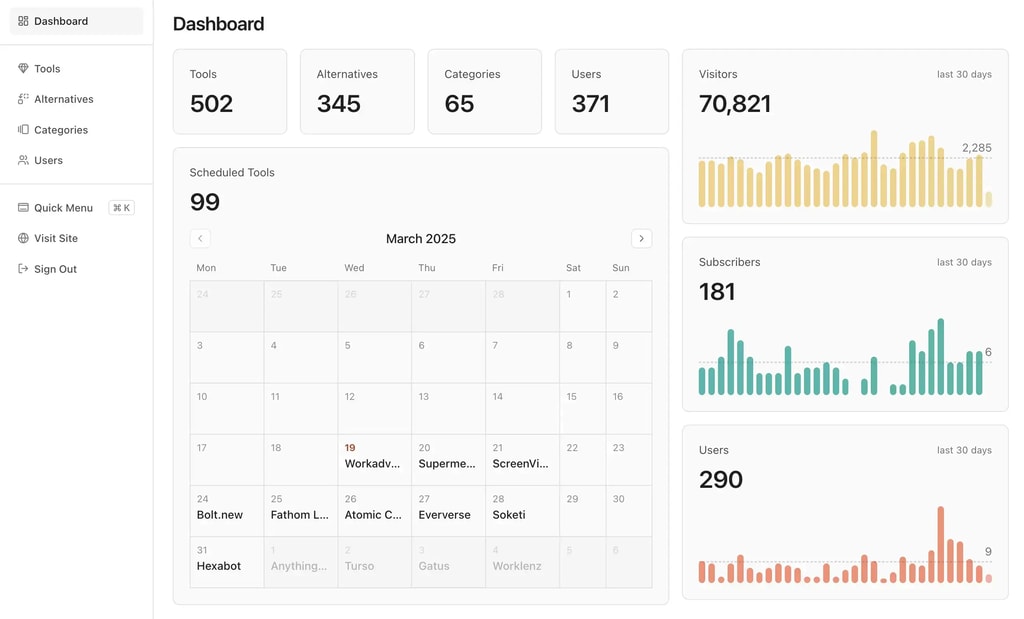
I've spent the last few years building businesses on Next.js: OpenAlternative (now around $6,500/month), and before that a string of client projects. I've bought boilerplates, used free starters, and built my own from scratch. Here's the short answer to this article's promise: the best Next.js template depends entirely on what you're building. For SaaS it's ShipFast or supastarter, for directories it's Dirstarter (my product, bias disclosed below), for blogs it's the Tailwind Nextjs Starter Blog, and for pure learning it's create-t3-app.
This isn't a list scraped from GitHub trending. I verified every price and star count before publishing, and I'll tell you who each Next.js boilerplate is actually for, including who should skip it.
How to Choose a Next.js Template (Before You Spend a Dime)
Three things matter more than the feature list.
Free starter vs paid boilerplate economics
The math is simple. Wiring authentication, Stripe, webhooks, a database, and transactional email yourself takes 40-80 hours, even with AI assistance. A paid boilerplate costs $199-349 one-time. If your time is worth more than $20/hour, the boilerplate wins the moment you ship a week earlier.
But that only holds if you're building a business. If you're learning, the plumbing is the point, and a free starter teaches you more.
Code quality signals
Before buying anything, check the demo's source where possible and look for TypeScript everywhere, a real database schema (not JSON files), and documentation that goes beyond a README. For free templates, GitHub stars are a decent proxy for community vetting, but recent commits matter more.
Update cadence
Next.js ships breaking changes regularly. App Router, Server Actions, and the React 19 migration all broke older templates. A boilerplate that hasn't been updated in six months is a liability you're paying for. Check the changelog before checkout.
Pro tip: search the template's GitHub issues (or Discord) for "upgrade" before buying. How the maintainer handled the last major Next.js version tells you everything about how they'll handle the next one.
Best Next.js SaaS Boilerplates
1. ShipFast
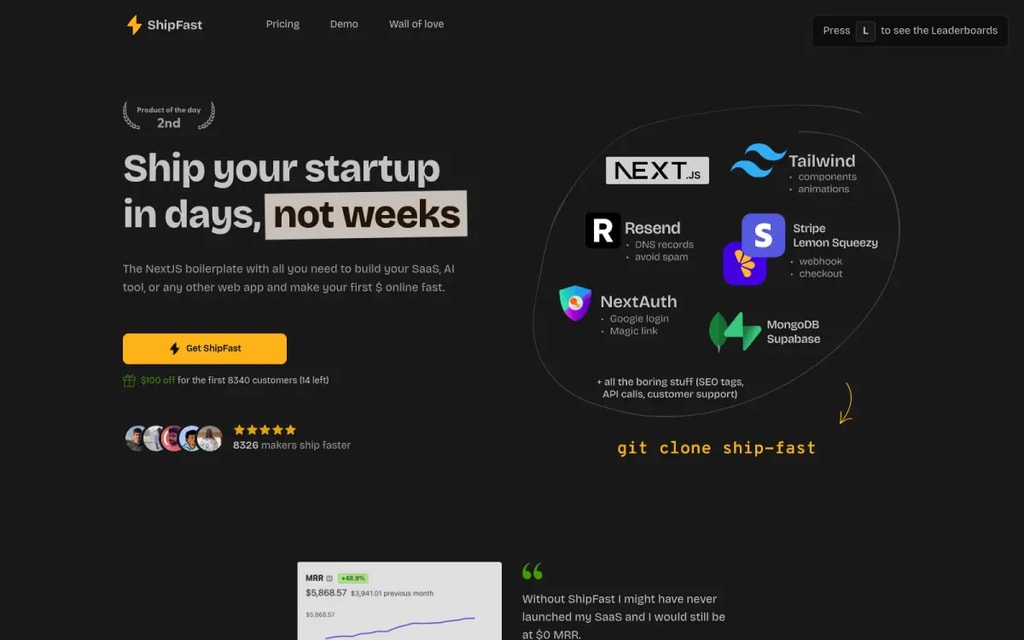
ShipFast by Marc Lou is the boilerplate that started the indie hacker boilerplate gold rush. You get Next.js with auth (Google OAuth and magic links), payments via Stripe or Lemon Squeezy, MongoDB or Supabase for the database, Mailgun or Resend for email, plus pre-built landing page components and SEO setup.
Pricing: tiers run $199 to $299 one-time at the time of writing (discounted from list prices of $299 and up), with lifetime updates and unlimited projects.
Honest fit: ShipFast is optimized for speed over architecture. The code favors "ship today" patterns, which is exactly right for solo founders validating ideas, and exactly wrong if you're building something you'll maintain with a team for years. For weekend-project velocity, nothing beats it.
2. supastarter
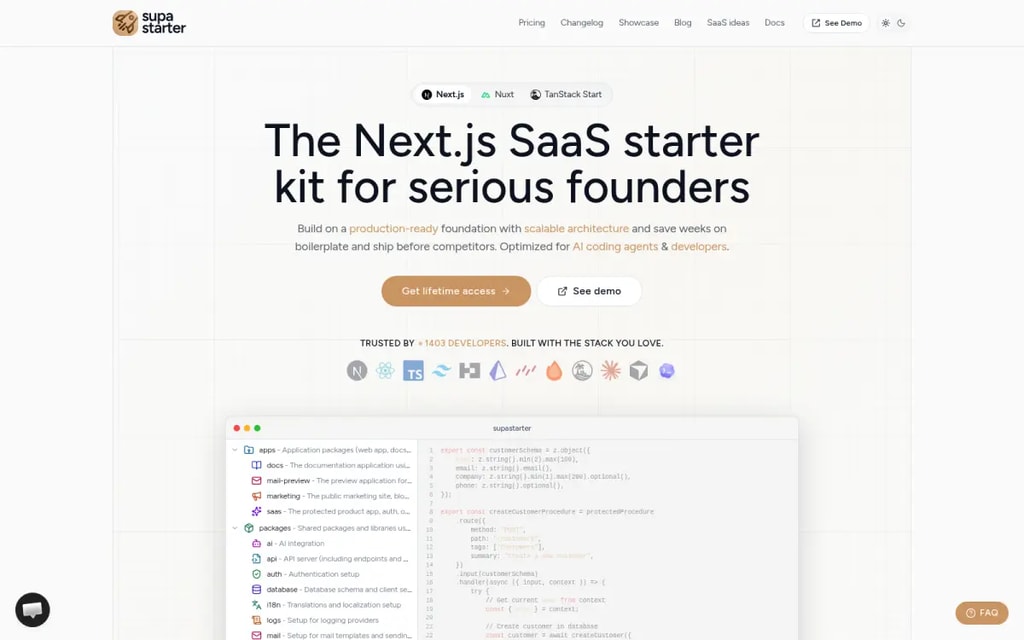
supastarter is the grown-up option. It supports Next.js, Nuxt, and TanStack Start, and ships with multi-tenancy (organizations with members and roles), internationalization, an admin panel, and a choice of five-plus payment providers including Stripe, Lemon Squeezy, Polar, Creem, and Dodo Payments. Database access goes through Prisma or Drizzle.
Pricing: listed at $349 one-time for the Solo tier (1 developer, unlimited personal projects), with team tiers at $799 and $1,499.
Honest fit: this is the boilerplate for B2B SaaS where teams, seats, and roles are core to the product. It's more code to understand upfront than ShipFast, and the price reflects the scope. Overkill for a simple B2C tool.
3. Next.js SaaS Starter (free)
The official Next.js SaaS Starter from the Next.js team gives you Next.js, Postgres, Stripe subscriptions, and shadcn/ui, completely free under MIT. It sits at around 15,900 GitHub stars and demonstrates current best practices straight from the people who build the framework.
Pricing: free, MIT license.
Honest fit: the best free SaaS starting point, full stop. It's intentionally minimal, so you'll build your own admin, emails, and marketing pages. Pick this if you want clean foundations and don't mind doing the last 40% yourself.
Best Full-Stack Next.js Starters
4. create-t3-app
create-t3-app is a CLI that scaffolds a typesafe full-stack app from modular pieces: TypeScript, tRPC, Prisma or Drizzle, Tailwind, and your choice of auth. At roughly 29,000 GitHub stars, it's the most popular community starter in the Next.js ecosystem.
Pricing: free, MIT license.
Honest fit: the T3 Stack is opinionated in the best way, and end-to-end type safety via tRPC genuinely prevents bugs. But it's a starter, not a product boilerplate: no payments, no marketing pages, no admin. Choose it when you want great architecture and plan to build the business layer yourself.
5. create-next-app and the Vercel Templates gallery
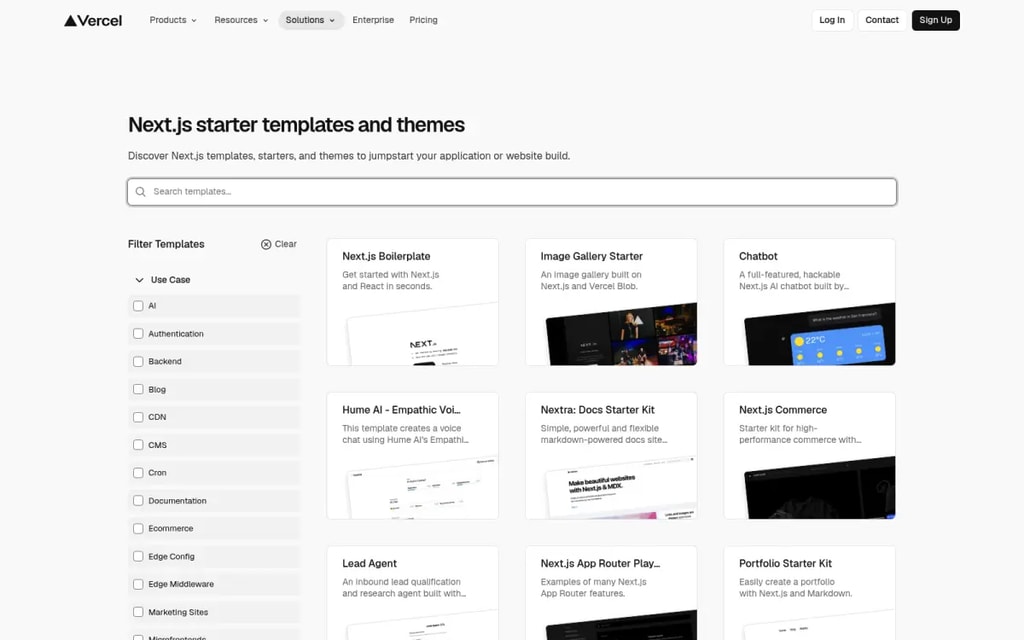
The official create-next-app CLI is where everyone starts, and the Vercel Templates gallery is the most underrated free resource on this list. It's filterable by use case (AI, blog, e-commerce, SaaS), CMS, database, and auth provider, with one-click deploys. Notable entries include the AI Chatbot and the Platforms Starter Kit for multi-tenant apps.
Pricing: free.
Honest fit: perfect for finding a proven reference implementation of one specific thing (say, Next.js + Sanity, or Next.js + Clerk). Don't expect any single gallery template to be a complete product.
6. Next.js Boilerplate by ixartz
ixartz's Next.js Boilerplate (about 13,000 stars, MIT) is a developer-experience powerhouse: TypeScript, Tailwind, auth, i18n, testing with Playwright and Vitest, logging, and a pile of pre-configured tooling that would take days to assemble.
Pricing: free, MIT license.
Honest fit: the best free option if your priority is tooling rigor (tests, linting, CI) rather than business features. The integration count cuts both ways: you'll spend your first hours removing services you don't need.
Best Next.js Directory Template
7. Dirstarter
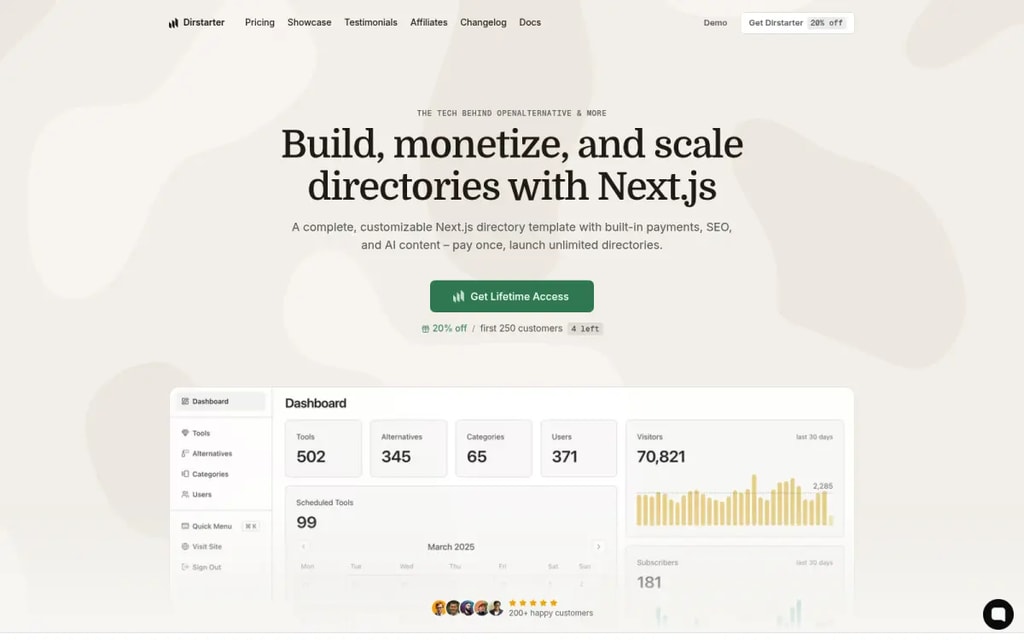
Full disclosure: Dirstarter is my product, so read this section knowing I'm biased. It exists because I built OpenAlternative from scratch and realized every directory needs the same machinery: listings, categories, paid submissions, featured placements, search, and an admin panel. No SaaS boilerplate ships any of that.
Dirstarter is a Next.js directory template with TypeScript, Prisma, Better Auth, and Stripe, plus AI content generation for populating listings, a built-in blog, and multi-language support. The site is itself built with the product, and at the time of writing it ranks #1 on Google for "next.js directory template". You can see what customers have shipped in the showcase.
Pricing: one-time payment starting at $149, with higher tiers adding priority support. Lifetime updates, unlimited directories.
Honest fit: if you're building a SaaS, buy ShipFast or supastarter instead, genuinely. But if you're building a listings business, a generic boilerplate means rebuilding the entire data model. I compared every alternative honestly (including competitors I like) in my directory boilerplate roundup, and if you're earlier than that, start with the full guide to starting an online directory business.
Best Next.js Blog Template
8. Tailwind Nextjs Starter Blog
Timothy Lin's starter blog (around 10,500 stars, MIT) has been the default Next.js blogging template for years, and it earns it. You get MDX content, dark mode, multiple analytics options, several comment system integrations, and tag pages, all statically generated and fast.
Pricing: free, MIT license.
Honest fit: the best replacement for a Jekyll or Hugo blog if you live in the React world. It's a content site, though: if your blog is the marketing arm of a product, you're usually better off with MDX inside your product's codebase than a separate repo.
Best Next.js Dashboard Templates
9. TailAdmin
TailAdmin offers a free Next.js admin dashboard (about 2,500 stars on GitHub, MIT) covering the standard admin furniture: tables, charts, forms, and auth pages. Pro versions unlock the full component set and Figma sources, starting at $59 one-time at current pricing.
Pricing: free core; pro tiers from $59 to $299 one-time.
Honest fit: a solid way to skip building internal admin UI. It's a UI kit, not an application, so all data wiring is on you. The free tier is generous enough that most indie projects never need pro.
10. shadcn/ui blocks and examples
shadcn/ui isn't a template in the traditional sense, and that's the point. The project (over 116,000 GitHub stars, MIT) gives you copy-paste components plus full dashboard examples and blocks you can drop into any Next.js app and own outright. No dependency to update, no license to buy.
Pricing: free, MIT license.
Honest fit: this is how I build UI now, and half the paid templates on this list are built on it. If you want a dashboard that doesn't look like a template, composing shadcn blocks beats buying one. The tradeoff is assembly time.
Pro tip: when evaluating any paid template, check whether it's built on shadcn/ui. If it is, customizing it later will be dramatically easier because you own the component code.
Best Next.js E-commerce Template
11. Next.js Commerce
Next.js Commerce (about 14,000 stars, MIT) is Vercel's official high-performance storefront starter for Shopify. It showcases the modern Next.js feature set: App Router, React Server Components, Server Actions, and optimistic UI, wrapped around Shopify's commerce backend.
Pricing: free, MIT license (you'll pay for Shopify itself).
Honest fit: the right choice when you want Shopify's backend with a fully custom, fast frontend. It's also one of the best codebases to read to learn current Next.js patterns. Not the right choice if you need a self-hosted cart or non-Shopify backend without significant rework.
Best Next.js Portfolio Template
12. Magic Portfolio by Once UI
Magic Portfolio (around 1,300 stars) is the cleanest free portfolio starter I've found: MDX-driven projects and blog, built on the Once UI design system, configured almost entirely through a single config file.
Pricing: free, but the license is not standard MIT, so read the terms before commercial use.
Honest fit: ideal for developers and designers who want a polished personal site in an evening without touching design decisions. If you want full creative control, you'll fight the design system; grab a barebones starter instead.
Which Next.js Template Should You Actually Pick?
Here's my honest decision tree after years of building with these tools:
| You're building | Pick | Cost |
|---|---|---|
| SaaS, solo, fast | ShipFast | from $199 |
| SaaS, B2B with teams | supastarter | from $349 |
| SaaS, zero budget | Next.js SaaS Starter | free |
| Directory business | Dirstarter | from $149 |
| Blog | Tailwind Nextjs Starter Blog | free |
| Admin dashboard | shadcn/ui blocks or TailAdmin | free |
| Online store | Next.js Commerce | free + Shopify |
| Portfolio | Magic Portfolio | free |
| Learning the stack | create-t3-app | free |
The pattern worth noticing: free Next.js templates are best when the template is the product (blogs, portfolios, dashboards). Paid Next.js boilerplates earn their price when there's a business layer (payments, subscriptions, admin, emails) that would eat weeks of your runway.
Whatever you pick, the template is maybe 10% of the outcome. OpenAlternative took me 48 hours to build and a year to reach meaningful revenue. The other 90% is picking a niche people care about and showing up every week. If that business happens to be a directory, my step-by-step build guide and the Dirstarter docs will get you from clone to launch in days, not months.