Programmatic SEO is the practice of generating hundreds or thousands of search-optimized pages from structured data instead of writing each one by hand. For a directory website, this isn't a growth tactic bolted on later. It's the core engine. Your listings are the data, your templates are the pages, and every category, comparison, and location combination becomes a landing page that can rank.
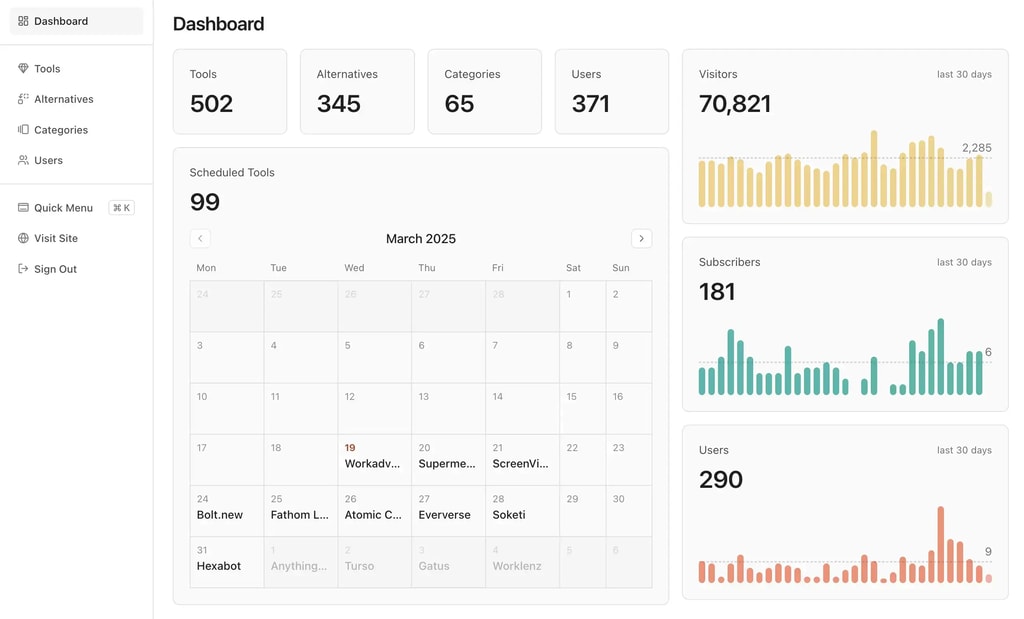
That's how directories win search. My own directory, OpenAlternative, gets around 70,000 visitors a month, and the majority arrive from organic search on pages I never wrote individually. They're generated from listing data.
In this post I'll cover the data model that makes it work, the five page templates every directory should ship, real programmatic SEO examples from Zapier, TripAdvisor, and Nomad List, and the thin-content trap that gets most attempts penalized.
Why Directories Are Built for Programmatic SEO
A blog scales linearly. One article, one page, one shot at ranking. A directory scales combinatorially.
Add a single listing and you don't just get one page. You get a listing page, a stronger category page, new comparison permutations against every related listing, and new entries on any "best X for Y" pages it qualifies for. Add 100 listings across 20 categories and you're suddenly sitting on thousands of potential landing pages.
Search demand is also combinatorial. Nobody searches "project management tools" once and stops. They search "free project management tools for freelancers", "Notion vs Trello", "project management tools with Gantt charts". Each long-tail query is low volume on its own, but together they dwarf the head term, and they're far easier to rank for.
Directories are the natural shape for capturing that demand. If you're still deciding whether this business model is for you, my pillar guide on how to start an online directory business covers the full picture. This post zooms in on the search side.
The Data Model Comes First
Every programmatic SEO failure I've seen traces back to the same mistake: starting with pages instead of data. The pages are just a rendering of your database. If the database is shallow, every page is shallow.
A directory data model has three layers:
Entities. The things you list: tools, agencies, restaurants, courses, podcasts. Each entity needs real substance: a description you actually wrote or curated, screenshots, pricing, links. This is your atomic unit.
Categories. How entities group together. Categories become your highest-volume landing pages, so they should map to how people actually search, not how you'd organize a spreadsheet. "AI writing tools" is a category people search for. "Miscellaneous SaaS" is not.
Attributes. This is where most directories are lazy and where the SEO leverage actually lives. Pricing model, platform, license, location, integrations, team size, dietary options, whatever fits your niche. Every structured attribute you collect unlocks a new page pattern: filter pages, combination pages, comparison tables.
On OpenAlternative, attributes like license type, tech stack, and self-hosting support are what let one set of listings power many distinct pages. Collecting them is tedious. It's also the moat, because anyone can scrape a list of names, but few people will sit down and structure 20 attributes per listing.
Pro tip: design your attributes by reverse-engineering search queries. Type your category into Google, check the autocomplete and "People also ask" suggestions, and every recurring modifier (free, open source, for teams, near me) is an attribute your database should capture.
Five Page Templates That Do the Heavy Lifting
With the data model in place, a handful of templates generate your entire search surface. These are the five that matter for directories.
Category pages
The workhorse. One page per category, listing every entity in it, targeting "best [category]" and "[category] tools/agencies/restaurants" queries. These carry your highest-volume keywords and should be your most polished template: intro copy, sorted listings, filters, and links down to individual listings.
"Best X for Y" combination pages
Cross a category with an attribute and you get pages like "best CRM for freelancers" or "free email marketing tools". These target commercial long-tail queries with strong intent and weak competition. The trap: only generate combinations where you have enough listings to be credible. Three results on a "best X for Y" page reads as thin to both users and Google.
Comparison pages
"X vs Y" pages, generated for pairs of listings within the same category. Comparison searchers are deep in decision mode, which makes these pages disproportionately valuable for affiliate revenue and featured placements. Render the comparison from attributes (pricing, features, platforms) side by side rather than writing prose for every pair.
Location pages
For local directories: "[category] in [city]". These work brilliantly when each city genuinely has different listings, and they get sites penalized when every city page shows the same content with a swapped city name. More on that in the thin-content section, because Google explicitly calls this pattern out.
Individual listing pages
One page per entity. Alone, each targets navigational queries like "[tool name] review" or "[tool name] pricing". Collectively, they're the foundation everything else links down to. This is also where structured data (schema markup) earns rich results in search.
Building these templates from scratch is a few weeks of work in Next.js. It's a solved problem though: my guide on how to build a directory website walks through the stack, and Dirstarter ships all five template types pre-built, since this is exactly the architecture I kept rebuilding for every directory I launched.
Programmatic SEO Examples Worth Studying
The best way to internalize these patterns is to look at sites doing it at massive scale. Three programmatic SEO examples come up constantly, and for good reason.
Zapier generates a landing page for every app it supports and for every combination of apps, which Zapier itself describes as thousands upon thousands of programmatic pages in its own write-up on programmatic SEO. Someone searching "Google Sheets and Slack integration" lands on a dedicated page for exactly that pairing. That's the "best X for Y" combination pattern executed at the scale of an entire app ecosystem.
TripAdvisor owns the "things to do in [city]" query space with location pages. Every page follows the same structure, but each is populated with attractions, reviews, and photos unique to that destination. The template is identical; the data isn't. That distinction is the entire game.
Nomad List is the most relevant example for solo founders. Pieter Levels built a directory of cities for remote workers, and every city page is rendered from structured attributes: cost of living, internet speed, safety, weather. One person, one database, one template, and it became the default resource for an entire community.
Notice what all three have in common. None of them generate text for the sake of generating pages. They collect proprietary or hard-to-assemble data and render it through templates. The data is the product; the pages are the distribution.
How OpenAlternative Generates Its Search Traffic
Here's my own worked example. OpenAlternative is a directory of open source alternatives to popular software. I built the first version in 48 hours, and it now does around $6,500/month, which I've broken down fully in the OpenAlternative case study.
The core programmatic pattern is "best [proprietary tool] alternatives" pages. Every popular SaaS product in the database gets a page listing its open source alternatives, generated entirely from listing data: which tools are tagged as alternatives, their licenses, their stacks, their GitHub activity.
On top of that sit category and use-case combination pages, crossing what the tool does with how people want to run it. The listings are entered once; the pages multiply from there.
The result is that the bulk of that traffic arrives spread across a long tail of generated pages. No single page is a blockbuster. The portfolio is.
This traffic shape also drives the monetization. Advertisers and featured listings ($197/month on OpenAlternative) pay for placement precisely because the programmatic pages capture buyers at the moment of choosing a tool. If you want the full menu of options, I've written about all five approaches in directory revenue models.
Pro tip: enrich listings from authoritative APIs where you can. OpenAlternative pulls live GitHub data (stars, last commit, contributors) into listing pages. It keeps pages fresh without manual updates and adds data competitors can't be bothered to integrate.
The Thin-Content Trap and Google's Scaled Content Abuse Policy
Now the warning label, because programmatic SEO has a graveyard, and it's full of sites that generated pages without generating value.
In March 2024, Google updated its spam policies to explicitly target this with a policy called scaled content abuse. The official definition is blunt: "Scaled content abuse is when many pages are generated for the primary purpose of manipulating search rankings and not helping users." Google announced the update alongside core changes aimed at cutting unhelpful content in results, and enforcement ranges from ranking demotions to full removal from the index.
Two details matter for directory builders.
First, the policy is method-agnostic. Google's examples include using generative AI to produce pages without value, scraping feeds or search results into pages, and stitching content from other sites together. Template-generated pages and AI-generated pages are judged the same way: by whether they help the user.
Second, Google separately flags doorway abuse, which includes creating many pages "targeted at specific regions or cities that funnel users to one page". That's the lazy location-page pattern: 500 city pages with identical content and a swapped city name. If your Chicago page and your Denver page differ only in the H1, you're describing doorway pages.
The practical test I apply to every template: if I deleted the database and kept only the boilerplate text, would the page say anything? A good programmatic page is mostly data: listings, attributes, comparisons, counts, screenshots. A bad one is mostly filler prose wrapped around a keyword. Generate pages only where the data exists, noindex or skip combinations that come back nearly empty, and you're on the right side of the policy.
Internal Linking Architecture
Generated pages don't rank in isolation. They rank because your site's structure passes authority down to them and helps crawlers discover them. With thousands of pages, internal linking can't be manual either. It has to be generated from the same data.
The structure that works for directories is a pyramid:
- Homepage links to top categories and featured listings.
- Category pages link down to every listing in the category and across to related combination pages ("best free tools in this category").
- Listing pages link up to their categories, across to similar listings and "X vs Y" comparisons, and to the alternatives pages they appear on.
- Combination and comparison pages link back to their parent category and to each listing they feature.
Every page should be reachable within three or four clicks from the homepage, and no generated page should be an orphan. Orphan pages (in the database but linked from nowhere) are the most common reason programmatic pages never get indexed.
Related-content modules do most of the heavy lifting here. A "similar tools" block on every listing page, generated from shared categories and attributes, creates thousands of contextual internal links for free.
Indexing and Sitemap Practicalities
A few unglamorous details decide whether your generated pages actually make it into Google's index.
XML sitemaps, auto-generated. Your sitemap must be built from the database at deploy time, never maintained by hand. Split large sitemaps into an index file with child sitemaps per content type (listings, categories, comparisons) so you can see in Search Console exactly which template types Google is indexing and which it's ignoring.
Expect partial indexing at first. A new domain publishing 5,000 pages will not get 5,000 pages indexed. Google allocates crawl attention based on trust, so early on, most pages sit in "Discovered, currently not indexed". The fix is patience plus authority: backlinks, consistent publishing, and pruning weak pages. Indexing compounds as the domain earns trust.
Structured data on every template. Schema markup (ItemList on categories, Product or SoftwareApplication on listings, FAQ where relevant, BreadcrumbList everywhere) helps Google parse generated pages and unlocks rich results.
Static generation where possible. Pre-rendered pages are crawled faster and more reliably than client-rendered ones. This is a big reason I build directories on Next.js.
This layer is exactly what Dirstarter handles for you: auto-generated sitemaps, schema markup, and SEO-optimized templates ship out of the box, and the docs cover how each piece works. Full disclosure, it's my product, but it exists because I got tired of rebuilding this same SEO plumbing for every directory.
Start With the Data, Not the Pages
Programmatic SEO is the reason a solo founder with a directory can compete with funded content teams. They can write 30 articles a month. Your database can render 3,000 pages, each answering a query too specific for anyone to target by hand.
But the order of operations matters. Pick a niche where structured data exists and is valuable (my list of profitable directory niche ideas is a good starting point). Build the data model with rich attributes. Then, and only then, generate pages, and only where the data makes them genuinely useful.
That's the whole playbook behind OpenAlternative's search traffic, and it's repeatable. If you want the broader roadmap from idea to revenue, start with my guide on how to start an online directory business. The directories winning search aren't the ones with the most pages. They're the ones with the best data behind each page.