Softr is a no-code platform that turns data sources like Airtable, Google Sheets, and Notion into working web apps: client portals, internal tools, dashboards, and simple websites. You pick a data source, drag pre-built blocks onto pages, set permissions, and publish. No code required.
That's the short answer to "what is Softr." The longer answer, and the point of this Softr review, is figuring out where it shines and where it quietly stops being the right tool.
My quick verdict: Softr is genuinely good at portals and internal tools. For public, SEO-driven websites like directories, it hits a ceiling that's expensive to discover after six months of work.
Quick disclosure before we start: I run OpenAlternative, a directory doing around $6,500/month, and I sell Dirstarter, a code-based directory boilerplate. I'm biased toward owning your stack. I'll flag that bias wherever it matters and give Softr full credit where it earns it.
What Is Softr?
Softr positions itself as "the first AI platform for business apps." The pitch: instead of buying expensive off-the-shelf software or hiring developers, non-technical teams build their own custom tools.
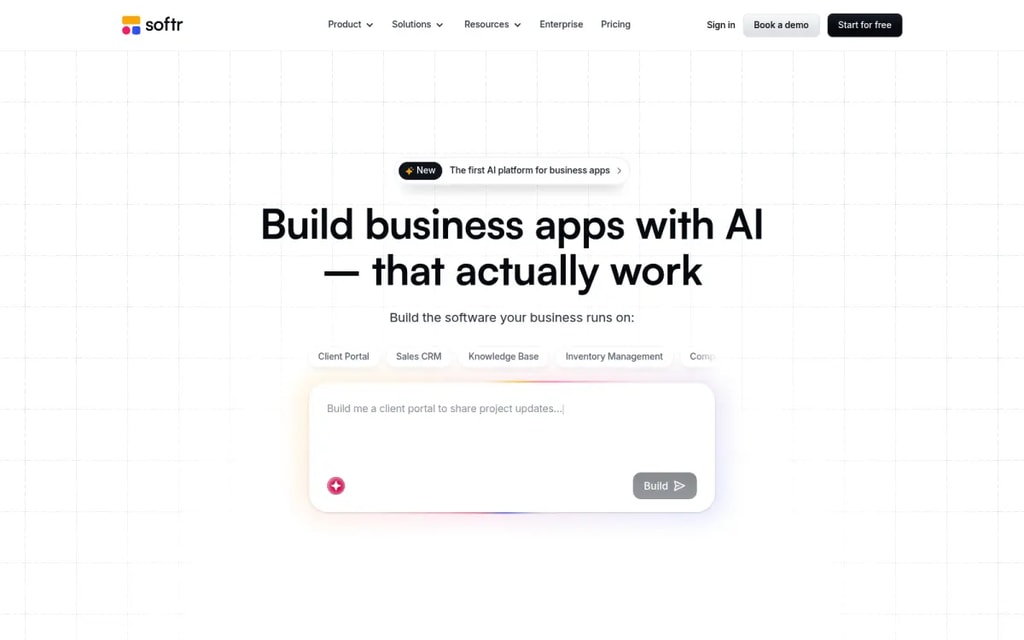
The company claims over 1 million teams use the platform, and its customer logos include some serious names. The typical Softr user isn't a startup founder building a consumer product. It's an operations person at a mid-sized company who needs a vendor portal, or an agency packaging Airtable data into something a client can actually look at.
The core use cases Softr promotes:
- Client and vendor portals: secure, login-gated interfaces for external users
- Internal tools: intranets, knowledge bases, inventory systems
- Business systems: lightweight CRMs, dashboards, approval workflows
- Simple websites and directories: public-facing pages built from the same blocks
Notice the order. Portals and internal tools come first because that's where the product is strongest. Public websites are the afterthought, which matters for the rest of this review.
How Softr Works
Softr's model is simple: your data lives somewhere else, Softr is the interface on top.
You connect a data source, then build pages out of pre-built blocks: list blocks, detail blocks, forms, tables, kanban boards, charts, calendars. Each block maps to your data and comes with built-in settings for layout, filtering, and search. You don't design from a blank canvas like Webflow. You configure blocks.
Supported data sources include Airtable, Google Sheets, Notion, SmartSuite, Xano, and Coda on every plan, with monday.com, Supabase, and ClickUp arriving on Professional, and SQL databases (PostgreSQL, MySQL, SQL Server) plus REST APIs reserved for the Business plan. Softr also ships its own built-in database now, which sidesteps the sync delays and API limits that used to plague Airtable-backed apps.
On top of the interface layer you get:
- User authentication and groups, so clients only see their own records
- Workflows and automations, metered by monthly action limits
- AI features, metered by credits, for generating apps and content
- Integrations with Stripe, Zapier, Make, n8n, DocuSign, and others
- PWA support to turn your app into something installable on a phone
The honest summary: for gluing a usable interface onto a spreadsheet in an afternoon, Softr is one of the best tools in the no-code space. I've watched non-technical founders ship working client portals in a weekend, something that would take a developer a week or more to build from scratch.
Pro tip: if you're evaluating Softr, build your real app on the free plan before paying. The block library is the product. If your idea fits the blocks, you'll know within a day. If you find yourself fighting the blocks on day one, that feeling never goes away.
Softr Pricing in 2026
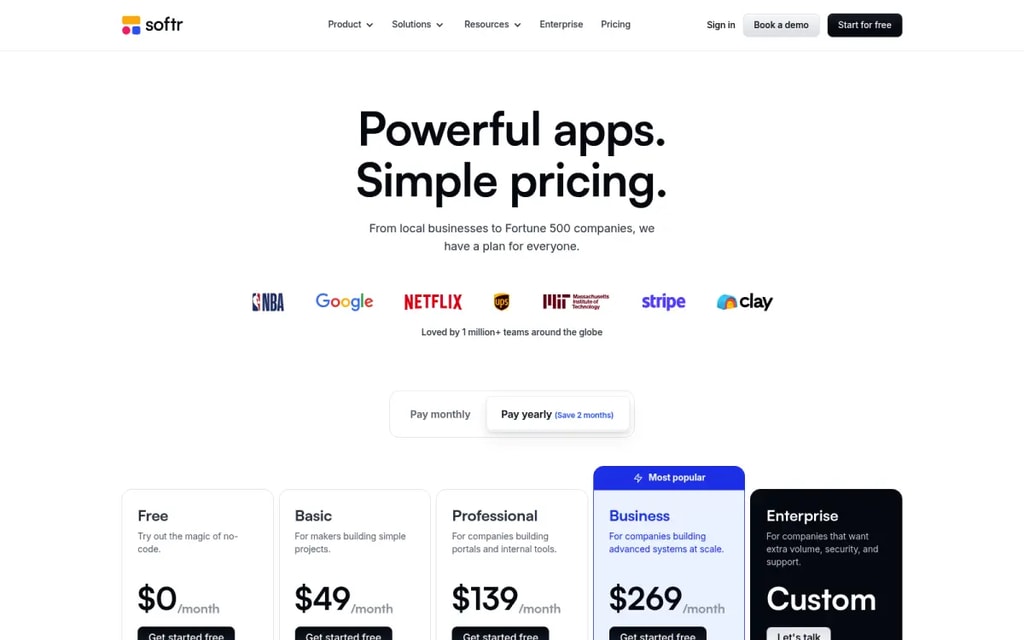
Here's the verified breakdown from Softr's pricing page at the time of writing. Softr advertises a saving of roughly two months if you pay annually, so monthly billing costs more than the figures below.
| Plan | Price | App users | Records | Highlights |
|---|---|---|---|---|
| Free | $0 | 10 | 5,000 | 1 custom domain, no custom code |
| Basic | $49/mo | 20 | 50,000 | Custom code, kanban, map, payment blocks |
| Professional | $139/mo | 100 | 500,000 | More data sources, CSV/PDF export, API calls |
| Business | $269/mo | 500 | 1,000,000 | SQL sources, REST API, unlimited user groups |
| Enterprise | Custom | Custom | Custom | SSO, SOC2 reporting, audit logs, SLAs |
A few details that matter more than the headline numbers:
Record limits are workspace-wide, not per app. If you run three apps on Basic, they share the 50,000 record pool.
Every plan includes exactly one custom domain. Extra domains cost $13/month each. If you're an agency running multiple client sites, that adds up fast.
Custom code is paywalled. The free plan doesn't allow it at all, which means no analytics snippets, no schema markup hacks, no CSS overrides until you pay.
The good integrations live upstairs. SQL databases and REST API connections require the $269/month Business plan. This is the most common pricing complaint I found in reviews, and I get it: needing Postgres shouldn't cost $3,228/year.
There are also AI credit add-ons ($10-500/month), extra user packs on Professional ($10 per 10 users, up to 250), and a 30% discount for non-profits and education.
For a funded team replacing a $20,000 internal tool build, these prices are a bargain. For a solo founder bootstrapping a content site, $139/month is $1,668 every single year, forever, before you've earned a dollar. Keep that number in mind for the directory section.
What Users Praise
I went through reviews on G2 and Capterra to find the recurring themes rather than cherry-picked quotes. Three things come up constantly.
Ease of use, by a wide margin. Reviewers consistently call Softr one of the simplest no-code platforms available. Non-technical builders ship dashboards and portals themselves instead of waiting on developers. This matches my experience watching people use it: the learning curve is measured in hours, not weeks.
The Airtable integration. Spinning up a branded interface on top of an existing Airtable base is Softr's killer feature and the reason most people find the product. Your team keeps working in Airtable, clients see a clean portal.
The built-in database. Reviewers describe Softr Databases as a game changer for performance, eliminating the sync delays and API rate limits that came with leaning entirely on Airtable. It's a sign the company is maturing past "Airtable frontend" into a standalone platform.
Where Users Complain
The same review sources surface three recurring frustrations, plus one softer signal.
Design customization runs out fast. This is the number one complaint. Softr feels limiting once you want real control: theme settings are shallow, many changes have to be made block-by-block instead of globally, and design freedom is nowhere near Webflow. Your site will look like a Softr site.
Performance degrades with large Airtable bases. Several reviewers note the interface slows down when querying big datasets through Airtable. Moving to Softr's native database helps, but that means migrating your data into the platform, which deepens lock-in.
Plan-gating and price creep. Custom code, API calls, SQL sources, exports: the features you eventually need sit one or two tiers above the plan you started on. Multiple reviewers feel the pricing is steep for what's unlocked at each level.
The softer signal: Trustpilot reviews are noticeably more mixed than G2, with some complaints about support quality. I weight Trustpilot less because frustrated users are overrepresented there, but the gap between platforms is worth knowing about.
One complaint deserves its own line because it's structural, not fixable: you can't export your app or its code. If you leave Softr, you leave with your data and nothing else. Every page, workflow, and permission rule gets rebuilt from zero.
The Ceiling: Softr for Directory Websites
This is where my bias kicks in, so let me restate it: I sell a code-based directory boilerplate. Discount accordingly. But I also run a directory with 70,000 monthly visitors, so the limits below come from operating experience, not theory.
A directory business lives or dies on organic search. At OpenAlternative, roughly 65% of revenue comes from ads and sponsorships and about 35% from $197/month featured listings, and all of it exists because thousands of individual listing pages rank on Google. That's the model for almost every directory in my revenue models breakdown. Now look at how Softr handles exactly that workload.
Detail pages are one dynamic block, not real pages. In Softr, all your listing detail pages render through a single List Details block. Because every record displays through the same page, you can't set SEO parameters in page settings. Instead, Softr's own docs tell you to add special fields to your database: SEO:Index, SEO:Title, SEO:Description, SEO:Slug. Your SEO config becomes spreadsheet columns. It works, but it's fragile, and fine-grained control over things like per-listing structured data remains a long-standing community feature request.
Sitemaps strain past 1,000 entries. Per Softr's documentation, once you have more than 1,000 indexed entries, the system can fail to add them to the sitemap automatically, and you trigger a manual regeneration by visiting a special URL. A thousand listings is a small directory. OpenAlternative passed that in its first months. A platform where the sitemap needs babysitting at 1,000 pages is telling you what it was built for, and it isn't programmatic SEO.
The design ceiling becomes a differentiation ceiling. Directories compete on trust and polish. When users say Softr sites all look like Softr sites, that's cosmetic for an internal tool and strategic for a public brand competing in search results.
The economics invert. Directories take time. OpenAlternative needed roughly a year before revenue got meaningful, and I'd built Chipmunk, a WordPress directory theme, before that, so I wasn't starting from zero. On Softr's Professional plan, that pre-revenue year costs $1,668, then $1,668 again every year after, with your entire site locked to a platform you can't export from. A one-time purchase, whether that's a WordPress theme or a Next.js boilerplate, flips that math permanently.
To be fair, there are directory shapes where Softr is fine: a private member directory for a paid community, an internal vendor list, a small curated collection where traffic comes from your newsletter instead of Google. If search isn't your growth channel, most of this section doesn't apply. For everything else, I'd work through the stack options in my guide to building a directory website before committing.
Pro tip: before building a directory on any no-code platform, search Google for site: plus the domain of an existing directory built on it, and count the indexed pages. If platform showcases can't point you to a single example with thousands of listings ranking, that's your answer.
Verdict: Should You Use Softr?
After this whole Softr review, here's where I land.
Use Softr if you're building a client portal, internal tool, or dashboard on top of Airtable or Google Sheets, especially inside a company where developer time is the bottleneck. It's one of the best tools in that lane, the free plan is generous enough for a real evaluation, and reviewers are right that nothing ships faster for that job. It's also a legitimate way to validate a directory idea in a weekend before investing in a proper build.
Skip Softr if you're building an SEO-driven directory or content business you intend to run for years. The block-based design ceiling, database-driven SEO workarounds, sitemap limits, single custom domain, and permanent subscription with no code export all push against what that business needs to compound.
My honest framing: Softr isn't a bad product that fails at directories. It's a good product built for a different job. The mistake is picking a portal tool for a search business.
If the SEO-driven path is the one you're on, start with my guide to starting an online directory business to get the full picture, and if you want the code-ownership route, that's exactly why I built Dirstarter: pay once, own everything, no ceiling. But validate the niche first. The tool matters far less than picking a market that's actually searching for what you'll list.