A local business directory is a website that lists businesses in a specific city or region, organized by category, so people can find a plumber, a wedding photographer, or a dog-friendly cafe near them. If you landed here as a business owner looking for directories to list on, the short answer is: claim your Google Business Profile, then Yelp, then the niche directories in your industry.
But this guide is for the other side of the table: people who want to start a local business directory and get paid by those businesses. That is a real opportunity. I run OpenAlternative, a directory doing around $6,500/month, and while it is a tech directory rather than a local one, the mechanics transfer almost perfectly: aggregate listings, rank in Google, charge for visibility.
Local has one extra advantage that tech directories do not: your customers have marketing budgets and almost nowhere good to spend them. Let me walk you through how I would build one today, step by step. If you want the broader playbook first, my guide on starting an online directory business covers the fundamentals.
Why a Local Business Directory Still Makes Money
The obvious objection: doesn't Google Maps already do this? Yes, and that is exactly why the opportunity exists.
Google Maps answers "plumber near me" fine. It does a terrible job with curated, opinionated, specific queries: "best patios for dogs in Austin", "wedding venues under $5,000 in Raleigh", "kid-friendly restaurants in Portland that take reservations". Those searches get answered by listicles and directories, and in most cities the sites ranking for them are thin, outdated, or owned by media companies that stopped caring years ago.
Meanwhile, local businesses spend real money on visibility. They are already paying for Google Ads, Yelp upgrades, and chamber of commerce memberships. A featured spot on a site that actually sends them customers is an easy yes at local price points.
The incumbents are weak in most cities. Legacy city guides run on ancient CMSes, newspaper directories are afterthoughts, and Yelp's relationship with business owners is famously sour. A focused operator with a fast site and fresh data can outrank them on the long tail within a year.
Two real examples prove the model works:
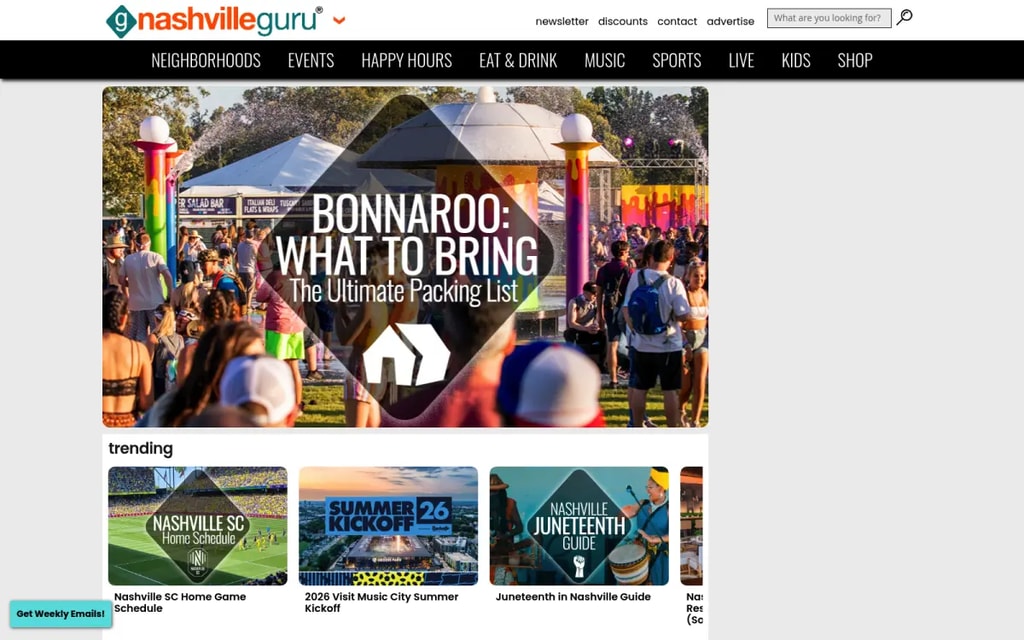
Nashville Guru has been running since 2010 as a guide to Nashville businesses, neighborhoods, and events. According to their advertising page, they reach 8,000+ daily readers and 170,000+ Instagram followers, and paid campaigns start at $500. Businesses can also upgrade their listings with photo galleries, descriptions, and social links. That is the featured listing model, executed well, in a single city.
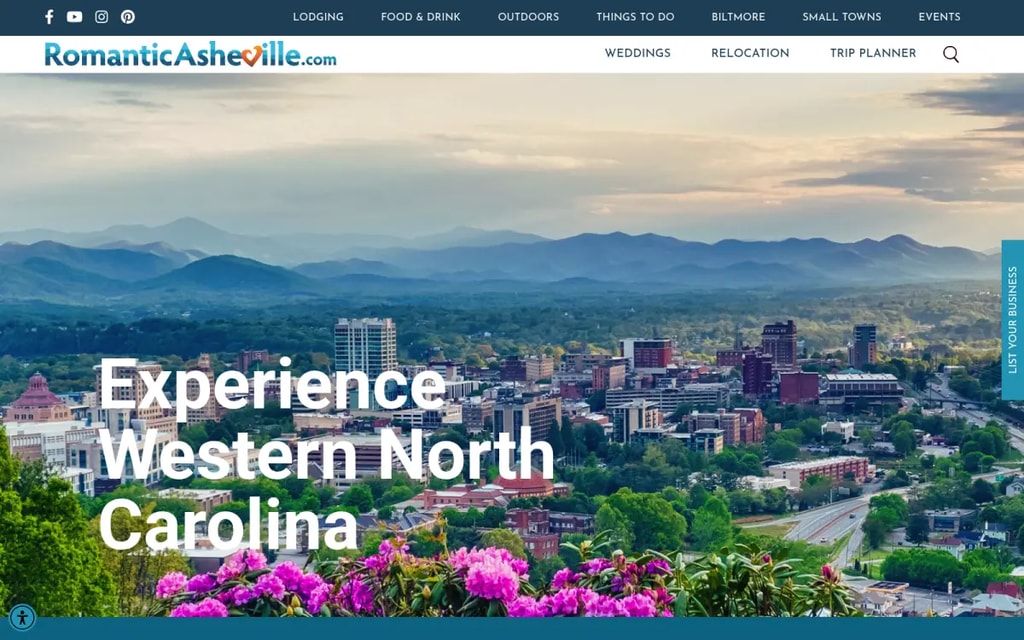
RomanticAsheville.com started in 2003 as founder Mark File's hobby project and grew into an 800+ page travel and business guide covering 15 counties around Asheville, North Carolina. The site reported millions of visits per year (5.2 million visits in 2015 per the Asheville Chamber of Commerce, and 6.13 million in 2020 per their own about page), all funded by advertising partners in lodging, dining, and attractions. One person, one region, a multi-decade business.
Neither of these is a unicorn story. They are durable, boring, profitable local media businesses. That is the ceiling you are aiming for, and the floor is a nice side income.
Pick a City + Niche Combo, Not Just a City
The biggest mistake I see: trying to build "the directory for everything in Denver". You will lose. City-wide directories compete with Google, Yelp, Nextdoor, and the local newspaper all at once, and your data maintenance burden scales with every category you add.
The winning move is city + vertical. One city, one niche:
- Wedding vendors in Charleston
- Dog-friendly businesses in Austin
- Kid activities and camps in Minneapolis
- Coworking and private offices in Lisbon
- Wellness studios in Denver
This combo wins for three reasons. First, the SEO is achievable: "wedding venues charleston sc" is winnable in months, "restaurants charleston" is not. Second, your buyer is concentrated: every advertiser is the same type of business with the same problem, so one pitch works for all of them. Third, depth beats breadth in the eyes of both users and Google. A 100-listing site that covers every wedding vendor in one city is genuinely useful. A 5,000-listing scrape of everything is not.
How do you pick the vertical? Look for businesses with high transaction values and active customer acquisition. Wedding vendors, home services, med spas, private schools, and venues all spend money to get found. Nail salons and coffee shops mostly do not. If the average customer is worth $500+ to the business, the business will pay you $50/month without blinking.
I keep a longer list of validated ideas in my post on profitable directory niches, and many of them get even better when you add a city to them.
Pro tip: search "[your niche] + [your city]" before committing. If page one is dominated by The Knot, Yelp, and one dead local blog from 2019, that is a green light. If there is a well-maintained local directory already ranking, pick a different vertical or a different city.
Seeding Your First 100 Listings
An empty directory is useless, so you seed it yourself. Nobody submits to a site with no traffic. The good news: local business data is largely public.
Start with public data sources. City business license registries, county records, and open data portals list registered businesses with names, addresses, and categories. Chamber of commerce member lists and industry association rosters are great for verticals like weddings or home services. OpenStreetMap data is free to use with attribution. What you should not do is bulk-scrape Google Maps: it violates their terms, and scraped data goes stale fast anyway.
Then comes the unsexy part that actually builds the moat: manual verification. For every listing, check the website still resolves, the phone number works, and the business is still operating. Add the details aggregators get wrong or skip entirely: price ranges, parking, whether they take walk-ins, real photos if you can get them. This takes a weekend or two for 100 listings, and it is the entire reason someone would use your site over Google.
Verification also doubles as your first marketing channel. When you email a business "I've listed you on the new Charleston wedding directory, can you confirm your details?", a meaningful chunk will reply, fix their info, and remember you. Those are your future featured listing customers, and you have not spent a dollar on ads.
For the technical side of actually building the site, importing data, and structuring listings, I wrote a full walkthrough on how to build a directory website.
The Local SEO Playbook
Local directories live or die on programmatic SEO. Your site structure should generate a page for every search a local customer might make.
The core unit is the category + location page: "Wedding Photographers in Charleston", "Wedding Venues in Mount Pleasant", "Florists in North Charleston". Each page lists relevant businesses with unique intro copy, filters, and a map. If your niche spans neighborhoods or suburbs, every category-neighborhood combination is a page. Twenty categories times ten areas is 200 indexable pages from day one, each targeting a query with commercial intent.
Three things make these pages rank:
Unique content per page. A two-sentence templated intro on every page is a thin-content penalty waiting to happen. Write real local context: what photographers in this area typically charge, which venues book out a year ahead, what neighborhoods locals actually recommend. This is where living in the city is an unfair advantage.
Local structured data. Mark up every listing with LocalBusiness schema (name, address, phone, hours, geo coordinates) and your list pages with ItemList schema. This helps Google understand your pages as a directory of local entities rather than a wall of text, and it makes you eligible for richer results. This is one of the reasons I built location pages and schema generation into Dirstarter out of the box (full disclosure, it is my product): wiring this up by hand for hundreds of pages is exactly the kind of work a boilerplate should eat.
Become a citation, earn citations. In local SEO, consistent name-address-phone mentions across the web are a ranking signal for businesses, which means businesses actively want to be listed on legitimate local directories. Use that. Your "suggest a listing" and "claim your listing" flows bring you free data updates and natural backlinks from businesses who link to their own profiles. Meanwhile, earn your own links the local way: local news loves data ("we analyzed all 214 wedding venues in Charleston, here's the average price"), and local bloggers and venues will link to genuinely useful resources.
One more thing: spend an hour learning how Google Business Profile works, even if your directory itself is online-only. Knowing GBP makes you better at selling to businesses, because you can talk to them about their whole local presence, not just your site.
How to Monetize a Local Directory
I run through every model in detail in directory revenue models, but local changes the math, so here are the specifics.
Featured listings are your core product, priced for local budgets. On OpenAlternative I charge $197/month for featured listings because my customers are venture-backed software companies. A local florist will not pay that. For local directories, $29-99/month is the realistic band: $29-49 for low-ticket businesses (cafes, salons), $79-99 for high-ticket ones (venues, contractors, med spas). The pitch is simple: top placement in their category, a badge, photos, and a link. Annual plans with two months free smooth out churn.
Local sponsor packages are your second product. Bundle homepage placement, a newsletter mention, and category sponsorship into a $150-500/month package for the handful of businesses in your niche with real marketing budgets. This is essentially what Nashville Guru does with campaigns starting at $500. One or two sponsors can match the revenue of ten featured listings, and local businesses understand sponsorship intuitively because they already sponsor little league teams and charity events.
Display ads come later. Programmatic ads need serious traffic to matter. Below 30,000-50,000 monthly visitors, ad networks will pay you coffee money while slowing down your site. Skip them until the traffic justifies it. When it does, selling ad spots directly to local businesses pays far more than programmatic networks — a tool like Revinel automates the booking and scheduling so it stays hands-off.
Lead generation works in some verticals. Home services, venues, and contractors will pay per qualified inquiry. It is more operationally heavy than featured listings, so I would treat it as a v2 experiment, not a launch model.
Pro tip: sell your first five featured spots at half price, in person or by phone, to businesses you verified during seeding. Local businesses buy from people, not from pricing pages. Those five logos become the social proof that makes the next twenty sales self-serve.
Realistic Numbers (From Someone Who Does This)
Let me set honest expectations, because most "make money with directories" content is fantasy.
OpenAlternative took me 48 hours to build, but roughly a year to reach meaningful revenue. Today it does about $6,500/month (~$80k/year) on roughly 70,000 monthly visitors, with ads and sponsorships at about 65% of revenue and featured listings around 35%. I shared the full journey in the OpenAlternative case study. Before that I spent years building Chipmunk, a WordPress directory theme, and watched hundreds of customers launch directories. The pattern is consistent: slow for months, then compounding.
For a local niche directory, the realistic path looks like this. Months one to three: build, seed, verify, publish your location pages, and earn close to zero. Months four to eight: long-tail rankings arrive, traffic grows to a few thousand visits per month, and you close your first handful of featured listings. By month twelve, a well-executed city + vertical directory at 5,000-15,000 monthly visits can support 20-40 paying businesses.
Run the math on the middle case: 30 businesses at $49/month is $1,470/month, plus one $300/month sponsor puts you near $1,800/month from a site you maintain a few hours a week. That will not replace a salary on its own, but it is a genuinely sellable asset, and the playbook repeats in the next city or the next vertical. I dig into benchmarks at every traffic level in how much directory websites make.
The failure mode is equally predictable: launch a scraped city-wide directory, get no traffic, quit at month four. The model rewards focus and patience, not volume.
Start This Week
Here is the whole plan in five lines. Pick a city + vertical combo where page one of Google is weak. Seed 50-100 listings from public data and verify every one by hand. Ship category + location pages with LocalBusiness schema. Email every business you listed. Sell featured listings at $29-99/month once traffic proves you send customers.
A local business directory is one of the few online businesses where your customers are easy to find (they are literally listed on your own site), the competition is mostly asleep, and the product gets more valuable every month as your data and rankings compound.
The build itself should be the easy part. If you do not want to spend months wiring up listings, location pages, payments, and schema from scratch, Dirstarter gives you all of it for a one-time ~$149. And for proof of what people actually launch with it, browse the showcase.
Pick your city. Pick your vertical. Go claim it before someone else reads this post.