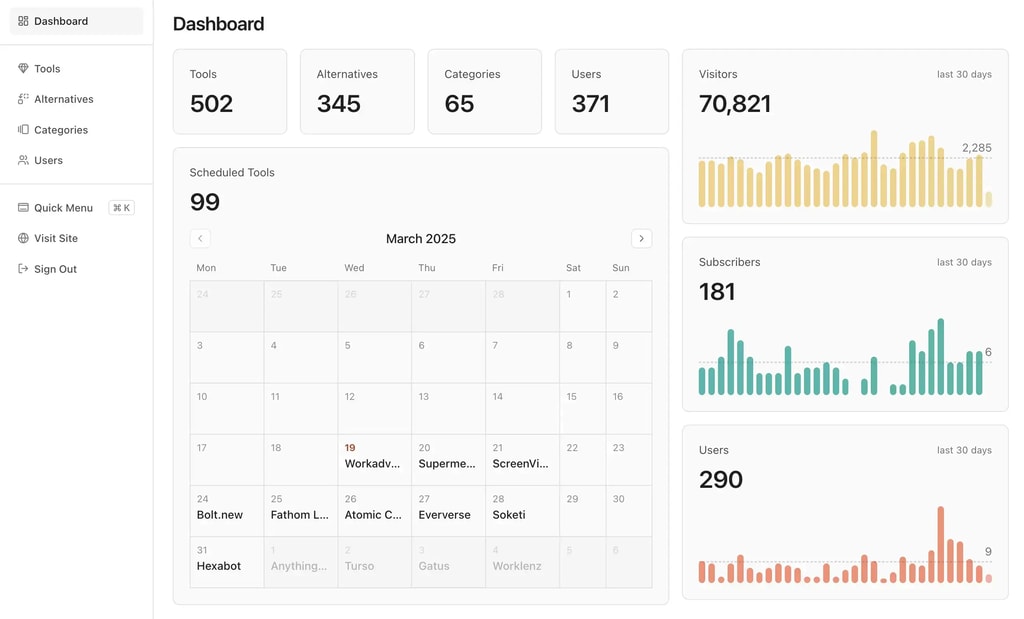
Picking directory software in 2026 means choosing between four very different paths: dedicated SaaS platforms, WordPress plugins, no-code builders, and code boilerplates. I run OpenAlternative, a directory doing around $6,500/month, and I build Dirstarter, a Next.js directory boilerplate. So yes, I have a horse in this race. I'll disclose that bias throughout and tell you when my product is the wrong choice.
Here's the short version. If you can't write code and want to launch this week, Brilliant Directories or Softr will get you there. If you live in WordPress, Directorist or GeoDirectory are solid. If you want full ownership and the ability to scale to thousands of SEO pages, a code boilerplate wins.
I verified every price in this post in June 2026, directly from the vendors' pricing pages. Let's go category by category.
The Four Categories of Directory Software
Before the tools, a quick map of the landscape, because comparing Webflow to a WordPress plugin without context is useless:
- Dedicated SaaS platforms: hosted, all-in-one business directory software. You rent the whole stack.
- WordPress plugins: directory functionality bolted onto a site you host yourself.
- No-code builders: general-purpose website builders bent into directory shape.
- Code boilerplates: source code you buy once, customize, and own forever.
Each category trades convenience for control. The further down the list you go, the more you own and the more skill you need.
Dedicated SaaS Directory Platforms
These are purpose-built for directories: member management, paid listings, lead capture, all included. You pay monthly, forever, and you never touch the code.
Brilliant Directories
Brilliant Directories is the biggest name in hosted business directory software. Everything is bundled: hosting, SSL, email, payment processing, and a library of directory themes.
As I write this, their pricing page lists three plans: Essentials at $40/month, Builder at $80/month, and Pro at $120/month, with a significant discount for annual billing. They run promotions constantly, so check the current page before quoting me.
Pros: genuinely fast to launch, monetization features (paid memberships, lead selling) built in, no technical skill required, and you can scale individual limits like members or storage without jumping plans.
Cons: your site looks like a Brilliant Directories site unless you invest heavily in customization. You don't own anything. And the monthly fee runs whether you're making money or not, which stings during the long pre-revenue stretch. It took OpenAlternative about a year to reach meaningful revenue, and that's normal for directories.
eDirectory
eDirectory has been around for two decades and skews more enterprise. Think chambers of commerce, associations, city guides.
Current pricing: the Professional Cloud plan is $99/month, Enterprise Cloud is $199/month, with roughly 25% off when billed annually. The interesting outlier is their Enterprise Source License at $1,499 one-time, which gets you the full PHP source code and the option to self-host.
Pros: mature feature set, unlimited listings on all plans, mobile app builders, and that source license is a rare ownership option in this category.
Cons: the stack is older PHP, the design feels dated next to modern sites, and meaningful customization usually means paying their team. The source license helps with lock-in, but you're inheriting a legacy codebase.
Pro tip: with any SaaS directory platform, calculate the 3-year cost before committing. Brilliant Directories' middle plan at $80/month is $2,880 over three years. That number changes the math against one-time alternatives fast.
WordPress Directory Plugins
WordPress powers a huge share of the directories I see in the wild, especially local ones. You handle hosting, the plugin handles directory logic. I know this corner of the market well: before Dirstarter, I built Chipmunk, a WordPress theme for directory websites. I wrote a full comparison of the best WordPress directory plugins if you want depth; here are the two I'd actually shortlist.
Directorist
Directorist is the flexible all-rounder. The core plugin is free on WordPress.org, which makes it the cheapest way to validate a directory idea this side of a spreadsheet.
Premium pricing currently runs $103/year for one site (regularly $129), up to $142/year for the agency tier, with lifetime licenses from $379 to $749 one-time. Every paid tier includes all 30+ extensions and themes, which I appreciate, because nickel-and-diming per add-on is the classic WordPress plugin trap.
Pros: free to start, monetization built in (paid listings, plans, featured placements), drag-and-drop form and layout builders, lifetime option available.
Cons: it's still WordPress. You're maintaining hosting, updates, caching, and security yourself, and a heavy plugin stack will slow your site down right where directories need speed most: SEO.
GeoDirectory
GeoDirectory is the specialist for location-based directories. If your project is "best restaurants in X" or any map-heavy local play, this is the WordPress plugin built for it.
The core plugin is free. Membership pricing is $139/year for a single site or $229/year for unlimited sites, covering all add-ons and themes.
Pros: built specifically for geo data and large location datasets, strong map integrations, and the unlimited-sites membership is good value if you're building a portfolio of local directories.
Cons: less suited to non-geographic directories (tools, software, resources), and the add-on architecture means real builds need the paid membership almost immediately.
No-Code Directory Website Builders
Neither of these is directory software in the strict sense. They're general builders that people increasingly use as a directory website builder, and for early validation they're hard to beat.
Softr
Softr turns Airtable or its own database into a working web app, directory templates included. There's a free plan with 5,000 database records, and paid plans currently start at $49/month for Basic, with the Professional plan at $139/month.
Pros: the fastest path from spreadsheet to live directory I know of. If your listing data already lives in Airtable, you can have a browsable, filterable directory online in an afternoon. Memberships and gated content are built in.
Cons: SEO is the weak point. Record limits, limited control over rendering and page structure, and you'll hit the ceiling quickly if your growth plan is thousands of programmatic pages. Softr directories are great MVPs and mediocre long-term SEO assets.
Webflow
Webflow gives you real design control without code, and its CMS maps nicely onto directory listings. Webflow overhauled its pricing in May 2026: the Basic site plan is now $15/month billed yearly, and the new Premium plan ($25/month yearly, $39 monthly) merges the old CMS and Business plans with 20,000 CMS items included.
That 20,000-item limit is the headline for directory builders. It used to take paid add-ons to get there, and it's now enough headroom for a serious mid-size directory.
Pros: best-in-class design freedom, clean semantic output, solid CMS for listings, and the new pricing is genuinely friendlier for content-heavy sites.
Cons: no built-in directory monetization (you're wiring up Memberstack or similar for paid listings), CMS limits still cap true programmatic SEO plays, and you're renting. Cancel the plan, lose the site.
Code Boilerplates: Own the Whole Thing
Full disclosure, again: this is my category. Dirstarter is my product, so weigh everything here accordingly.
A boilerplate is production-ready source code you buy once. Authentication, payments, admin panel, SEO architecture: pre-built, then it's yours to modify and deploy anywhere.
I'm biased toward this model because of how OpenAlternative happened. I built the first version in 48 hours on a code-first stack, and that same control is why it now pulls around 70,000 monthly visitors. Programmatic SEO, custom revenue models (ads and sponsorships are 65% of my revenue, featured listings at $197/month roughly 35%), structured data tuned per page type. None of that fits inside a hosted template.
Dirstarter
Dirstarter is a Next.js directory boilerplate with one-time pricing: currently $159 for the Basic tier and $199 for Pro, with no recurring fees and unlimited directories from one license. It ships with auth, Stripe payments, an admin panel, AI content generation, and the SEO setup I refined on OpenAlternative. You can see what people have shipped with it on the showcase.
Pros: you own the code outright, costs are fixed, and there's no platform ceiling on SEO, design, or monetization.
Cons: honestly, it's not for everyone. You need to deploy a Next.js app and be comfortable in a code editor, even if AI tools now do most of the heavy lifting. If "git" sounds like an insult, start with a hosted builder instead.
There are other solid options in this category too. I compared them, including competitors to my own product, in my directory boilerplate roundup.
Pro tip: even if you start on a no-code builder, keep your listing data in a clean, exportable format (Airtable, a spreadsheet, anything structured). Migrating data to a code stack later is easy. Recreating it is miserable.
Directory Software Compared
All prices verified June 2026 from official pricing pages:
| Tool | Category | Pricing | Code ownership | Time to launch | Scales with SEO |
|---|---|---|---|---|---|
| Brilliant Directories | SaaS | $40-120/mo | No | Days | Limited |
| eDirectory | SaaS | $99-199/mo or $1,499 once | Only source license | Days | Limited |
| Directorist | WP plugin | Free core, $103-142/yr, lifetime $379+ | Partial (GPL) | ~1 week | Good |
| GeoDirectory | WP plugin | Free core, $139-229/yr | Partial (GPL) | ~1 week | Good |
| Softr | No-code | Free, then $49-139/mo | No | Days | Weak |
| Webflow | No-code | $15-25/mo (site plans) | No | 1-2 weeks | Moderate |
| Dirstarter | Boilerplate | $159-199 once | Full | Days (for devs) | Excellent |
"Scales with SEO" is my judgment call based on control over page generation, rendering, and internal linking. Disagree if you like, but it maps to what I've watched work across hundreds of directories.
How to Choose the Best Directory Software
The best directory software for you comes down to three questions. Answer them honestly and the table above mostly picks itself.
What's your budget shape?
Not just the amount, the shape. Monthly fees feel small but compound: $99/month is $1,188/year before you've earned a cent, and most directories take months, not weeks, to find traction.
If you have cash now and want zero recurring costs, a one-time purchase (boilerplate, Directorist lifetime, eDirectory source license) protects you during the slow ramp. If you'd rather pay as you go and can stomach the meter running, SaaS spreads the cost out.
What's your technical skill, really?
Be brutal here. If you've never deployed anything, a boilerplate will frustrate you no matter what AI assistant you're using, and Brilliant Directories or Softr will feel like a superpower. If you can follow a deployment guide and debug an error message, code unlocks the highest ceiling. The middle path is WordPress: harder than SaaS, easier than raw code, with a giant ecosystem behind you.
If you do want to go code-first, my technical guide to building a directory website walks through the whole stack.
How big do you want this to get?
A 200-listing local directory for your city? Almost anything on this list works, pick the cheapest one you'll actually finish. A niche play targeting thousands of search terms with programmatic pages? The platforms fall away fast. Softr hits record limits, hosted SaaS hits template limits, Webflow's 20,000 CMS items helps but still caps you. At real scale, owning the code stops being a preference and becomes a requirement.
And before any of this, make sure the niche itself can support the business. I keep a list of 50 profitable directory niche ideas if you're still deciding what to build.
My Honest Recommendation
After a few years of building directories and the directory software behind them, here's how I'd actually advise a friend.
Non-technical and just validating? Softr or Brilliant Directories. Launch ugly, launch fast, see if anyone cares. WordPress person with a local niche? GeoDirectory for geo, Directorist for everything else. Technical, or AI-assisted and ambitious? Buy a boilerplate, own your stack, and build the SEO machine the platforms can't. That's the path I took with OpenAlternative, and it's why I built Dirstarter the way I did.
Whatever you pick, remember the software is maybe 20% of the outcome. Distribution, data quality, and persistence are the rest. The best directory software is the one that gets out of your way while you do that work. If you're starting from zero, begin with my full guide on how to start an online directory business, then come back and pick your tool.