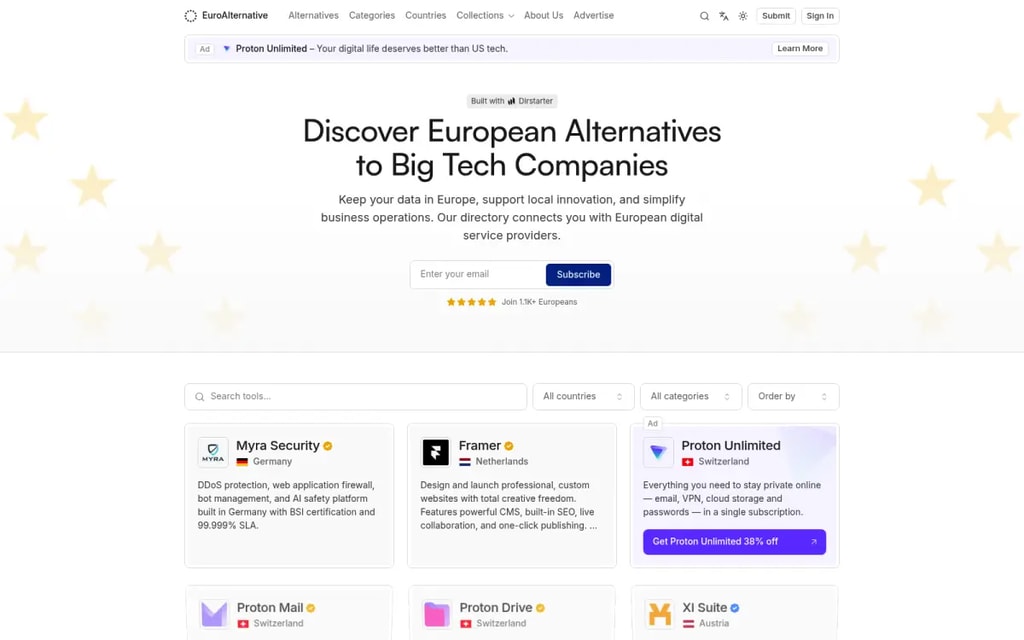
EuroAlternative is a directory of European alternatives to big tech software. I built it on Dirstarter in about five weeks, and it's also the live demo you land on when you click "See Demo" on this site.
This EuroAlternative case study covers the build, how I filled it with listings, and the search numbers. Google Search Console shows 347 clicks in February 2026, its first month, and 1,977 in August 2026. Almost all of that growth came from one page type: "European alternatives to X."
One note before the numbers. Every traffic figure below is clicks from Google Search, taken from Google Search Console. It's not total visitors, and I'm not sharing revenue for this site.
Why European alternatives
The idea came from my own business. I was looking for European cloud services and found them surprisingly hard to discover. Plenty of good companies exist, but no single place listed them.
There was also a clear search pattern. People were typing things like "European alternative to Google Photos" or "EU alternatives to Notion." That's the same query shape that made OpenAlternative work: a well-known product name plus "alternative." I already knew how to build pages for that kind of search.
The niche has one more advantage: the listing criteria are objective. A tool is either headquartered and owned in Europe or it isn't. The about page spells out the rules. The company needs its headquarters in the EU, EEA, EFTA, the UK, an EU candidate country, or a European microstate. Parent companies must be European too, and hosting providers must run their own European infrastructure instead of reselling AWS. Clear rules make curation faster and easier to defend.
How I built a directory website on Dirstarter in five weeks
The first EuroAlternative-specific commit is dated December 29, 2025. The Wayback Machine's first capture of the homepage is from February 4, 2026, and Google recorded the first clicks on February 3. So the build took about five weeks, including the holidays.
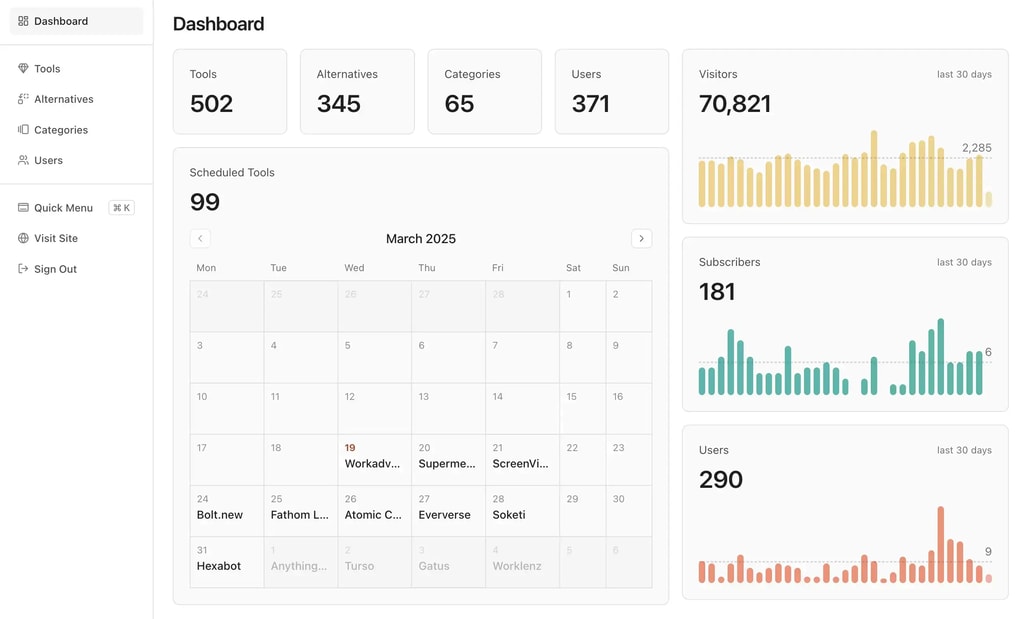
Most of the site came directly from Dirstarter: tool listings, categories, tags, search, the admin dashboard, user accounts, the submission flow, Stripe payments, sitemaps, structured data, and AI content generation. I didn't touch any of that in the first weeks.
What I added was the part that makes this niche work:
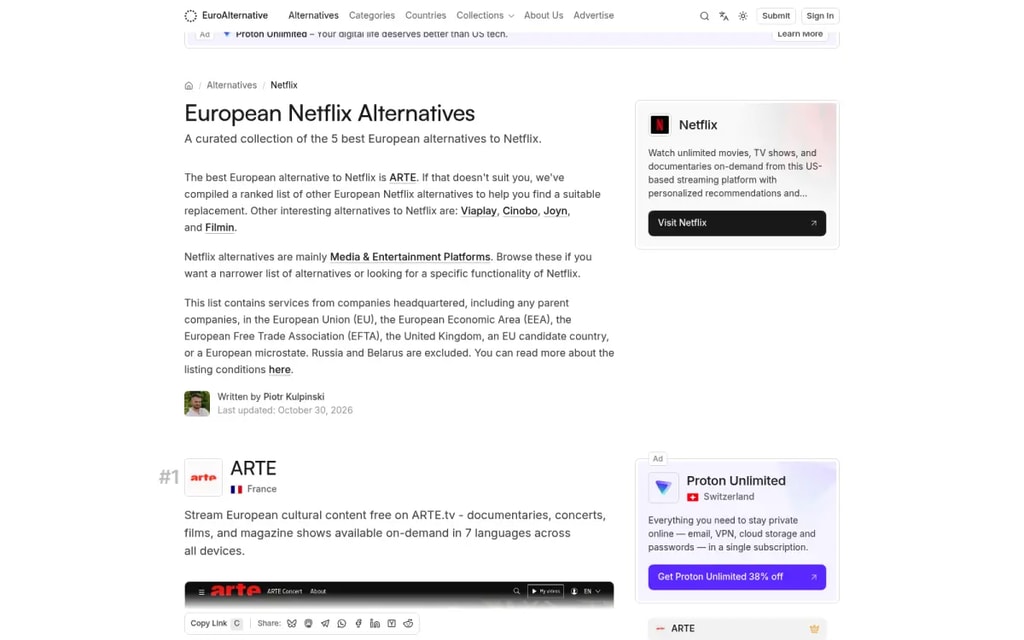
- An Alternative entity: the big tech product being replaced (Netflix, Gmail, Cloudflare), with its own admin screens and a public page listing every European option.
- A Country entity, so each tool carries a country and each country gets a listing page.
- Sitemap entries for both new page types.
- EU-themed branding, including an EU star pattern for logo placeholders.
A few days after launch I spent time on speed. The commit from February 10 lists 1,281 pages pre-rendered at build time and static page responses dropping from 1-2.5 seconds to 50-200 ms. Visitors judge a directory by how fast its category pages load, so I treated speed as part of the launch.
In July 2026 I translated the site. German came first, then French and Polish, then Spanish and Italian. Dirstarter already ships next-intl for the interface. I added locale-prefixed URLs (/de/..., /fr/...) and a step that translates listing content when it's written, not on every request. Every page now exists in six languages, each with its own entry in the sitemap.
How I seeded the listings
The hard part of a curated directory is saying no. EuroAlternative gets plenty of submissions that are thin AI wrappers, weekend projects, or companies that aren't European at all.
So I built a small command-line pipeline on top of Dirstarter's automation. Every pending submission goes through five steps:
- Evaluate. An AI model scores the tool from 0 to 100 using the scraped website and a web search through Jina. Some flags reject a tool outright: an AI wrapper, a vibe-coded side project, no real product, or not European. The same step checks which country the tool most likely comes from and lists the evidence.
- Reject. Rejected submissions are removed from the database.
- Enrich. This writes the description and adds the screenshot, categories, tags, the big tech products it replaces, and any affiliate link.
- Create alternatives. If a tool replaces a product that isn't in the database yet, that product gets its own page.
- Schedule. Approved tools go into Dirstarter's publishing calendar, so new listings trickle out instead of landing all at once.
In June I added a domain-age signal, because a domain registered in the last 90 days plus a thin product often means a vibe-coded app. I also changed how listings are sorted. Category, country and alternative pages now rank tools by an "establishedness" score built from organic traffic, domain authority and domain age, so a ten-year-old company appears above last week's launch. Paid Premium listings still come first.
Today the site lists about 480 tools across 50 categories and 32 countries, plus roughly 340 "alternatives to X" pages. Germany leads with 90 tools, followed by France (68), the Netherlands (49) and Poland (41).
SEO and traffic growth
Here's the monthly picture from Google Search Console:
| Month (2026) | Google clicks | Google impressions |
|---|---|---|
| February | 347 | 16,400 |
| March | 381 | 28,900 |
| April | 401 | 33,900 |
| May | 314 | 34,400 |
| June | 607 | 47,000 |
| July | 929 | 64,100 |
| August | 1,977 | 153,400 |
| September | 1,778 | 145,300 |
| October (to the 28th) | 1,440 | 112,400 |
The first four months were flat at 300-400 clicks. Impressions grew, but the average position sat in the mid-20s and slipped to about 35 in May. That's normal for a new domain. Google shows the pages to see how they perform before it trusts them.
From June, clicks started climbing. Daily clicks went from about 5-25 a day in February to about 40-70 a day from August to October, with a peak of 105 clicks on August 31. Daily impressions grew from a few hundred to 3,000-7,000. The average position improved from about 35 in May to 13.5 in September.
Where the clicks land
In the 90 days to October 28, the site got about 5,300 Google clicks. About 81% of them landed on "alternatives to X" pages. The top pages tell the story:
| Page | Google clicks (90 days) |
|---|---|
| European alternatives to Netflix | 186 |
| Homepage | 130 |
| European alternatives to Claude | 129 |
| European alternatives to Google Photos | 129 |
| European alternatives to Booking.com | 107 |
| European alternatives to Substack | 102 |
| European alternatives to Uber | 93 |
| European alternatives to WeTransfer | 87 |
| European alternatives to Google Pay | 86 |
| European alternatives to Discord | 79 |
The queries are long-tail. The brand name "euroalternative" brought 40 clicks. After that come "european search engines" (17), "european alternatives" (16), "eu alternatives" (11), and phrases like "european discord alternative" and "substack european alternative." No single query matters much. Hundreds of small ones add up.
Category pages help a little. Web browsers (71 clicks) and search engines (61) made the top 15. Country pages didn't, which surprised me. People search for the product they want to replace, not for the country it comes from.
The translation question
About 1,300 of those 5,300 clicks, roughly a quarter, went to the translated pages. The languages also match where the traffic comes from. Across 2026, Germany sent the most Google clicks (1,134), then the Netherlands (813), France (599), Spain (465) and Italy (438).
The big jump came in August, a few weeks after the translations went live. I can't separate the two effects cleanly, because the English pages were climbing at the same time. My honest read is that translations added a meaningful slice on top of a site that was already growing.
How EuroAlternative makes money
EuroAlternative uses the standard Dirstarter monetization setup. Submissions go through Dirstarter's listing plans: a free queue, and paid tiers with a do-follow link and faster review. The Premium tier adds featured placement, and on category pages paid tiers sort above the establishedness score.
Advertising runs through Revinel, my ad-serving product. It fills a banner and in-listing ad slots and handles bookings on the advertise page. The enrich step also attaches affiliate links where a listed tool has a program.
I'm not publishing revenue for this site. It earns money, and the setup is the same one you get out of the box. If you want to model what a site at this traffic level could earn, the directory revenue calculator is a reasonable starting point.
What worked and what didn't
What worked:
- Alternative pages. One template, a few hundred big tech products, and each page answers a specific search. This page type brings in over 80% of the Google clicks.
- Strict, public listing rules. They make the evaluation step easy to automate, and the reject rate keeps the directory credible.
- Starting from a boilerplate. Five weeks went into the parts unique to this niche, not into auth, payments, or an admin panel.
What didn't, or not yet:
- Country pages. They exist and get indexed, but none rank well enough to show up among the top pages.
- High-impression, low-click queries. "startpage alternative" showed up 7,900 times in 90 days at an average position of about 9, and earned 7 clicks. Ranking on the first page isn't the same as winning the click.
- The UK. It brought 64,500 impressions this year at an average position of 36, but only 384 clicks. That's the same impression level as Germany with a third of the clicks.
- The first four months. Nothing I shipped in March and April moved the numbers quickly. The site needed time.
Lessons if you're building your own directory
Find the query shape before you build. "European alternative to X" is a pattern people type thousands of times, with a different X each time. If your niche has a pattern like that, build one page type around it and generate it from your data.
Make your listing criteria checkable. Objective rules can be automated. Vague ones turn into hours of manual review.
Plan for a slow start. The first four months were flat. Give a new domain six months before you judge the niche.
Translate when your traffic says so. I only added languages after Search Console showed that most clicks came from Germany, the Netherlands, France, Spain and Italy.
Reuse the boring parts. Auth, payments, admin, sitemaps and submissions are the same in every directory. Your time is better spent on the one or two entities that make your niche different.
If you want to see what this looks like in practice, EuroAlternative is the live Dirstarter demo, and you can browse more sites built with Dirstarter. The software directory template is the closest starting point to this one.