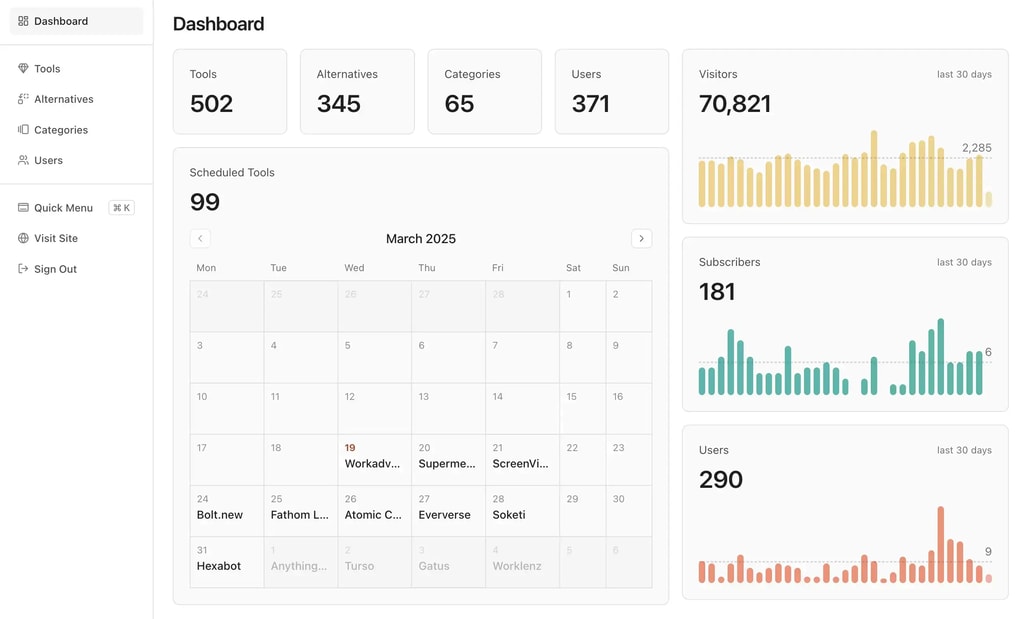
Dirstarter is a SaaS directory template built on Next.js. It gives you a software directory with submissions, paid listings, ads, verified ownership and SEO, as code you own after a one-time payment.
A software directory is the use case I built it for. Dirstarter started as the codebase behind OpenAlternative, my directory of open source alternatives, which makes about $6,500/month. DevSuite, Awesome Tools and the Dodo Payments Index run on the same base.
What a software directory needs
Software directories compete on curation and search traffic. The sites that work have these in common:
- Rich listing pages. Each product page needs a solid description, a screenshot and a link, and it should rank for the product's name.
- Category pages that rank. Most search traffic for a SaaS directory lands on category pages like "best CRM tools".
- A self-serve submission flow. Founders launch constantly and want to get listed without emailing you.
- Paid visibility. Featured spots and sponsored placements for companies with marketing budgets.
- Vendor ownership. Software companies want to manage their own listing, and a verified badge builds trust with visitors.
How Dirstarter covers it
Listings. Add a URL and the automation pipeline scrapes the site, writes the description with AI, assigns categories, and saves a screenshot and favicon. You review and schedule. A cron job publishes on time and updates the sitemap.
Category, tag and collection pages. Every category and tag gets its own page with structured data and a sitemap entry, and category pages get their own Open Graph image. Collections are saved filters defined in one config entry, for slices like "Self-hosted" or "AI-native" (two of the collections on OpenAlternative).
Submissions and payments. Guests can start a submission and sign in when they submit. They pick Free, Standard (one-time, do-follow link) or Premium (monthly, featured spot) and pay through Stripe. Details are in the monetization docs.
Ownership and badges. Vendors verify a listing through an email on their domain or a one-time code. Verified listings get a badge, and owners get an embeddable badge for their own site, which earns you backlinks.
SEO and AI visibility. Structured data, sitemaps and Open Graph images are built in (SEO docs). A public MCP server lets AI assistants search your catalog and link to your listings.
Ads and bookmarks. Ads run through Revinel in a banner, listing cards and a sidebar slot. Signed-in users can bookmark tools.
What you'd build yourself: user reviews and ratings, side-by-side comparison pages, and niche data like GitHub stars or licenses. OpenAlternative's "alternatives to X" pages and its GitHub data are custom code on top of the base. If programmatic pages are your plan, read programmatic SEO for directory websites.
How to make money with a software directory
Software companies pay for distribution, and a well-ranked software directory is a steady source of it. These are the models that work for me:
- Ads and sponsorships. About 65% of OpenAlternative's revenue. Banner slots and sponsored cards sell well once traffic is steady. OpenAlternative has about 200,000 monthly visitors.
- Featured listings. OpenAlternative charges $197/month, which is about 35% of its revenue.
- Paid submissions. A one-time fee for a do-follow link and a faster listing. This is the easiest first sale for a new directory.
- Affiliate links. Many SaaS products pay recurring commissions on referred customers.
For context, SaaS Hub makes about $120k/year. It took me about a year to reach meaningful revenue with OpenAlternative, and the full story is in the OpenAlternative case study. More models are in directory revenue models.
Launch checklist
- Buy Dirstarter and follow the introduction to set up the database, auth and environment variables.
- Pick an angle narrower than "all software": open source, a region, a stack or one job role.
- Define your categories and seed 100-200 products by pasting URLs into the admin.
- Review the AI-generated listings and fix anything off before publishing.
- Create your Stripe products and set prices for paid submissions and featured spots.
- Connect Revinel for ads and add affiliate links where programs exist.
- Deploy, submit your sitemap and email the vendors you listed so they can claim and share their listings.
A SaaS directory template handles the build. Rankings and revenue come from curation and patience. See the pricing, or compare Dirstarter with WordPress and Directify.