Softr is a decent product. I said as much in my full Softr review last week. But "decent at many things" is exactly why people end up searching for Softr alternatives: it builds client portals, internal tools, websites, and directories, and it isn't the best option for any single one of them.
Here's the short answer. For client portals and internal tools, use Glide or Noloco. If your data already lives in Airtable, use Airtable's native Interfaces. For marketing sites, use Webflow. For full web apps with custom logic, use Bubble. For directory websites, use WordPress on a budget or a code-based boilerplate like Dirstarter if you're serious (I built it, so factor in my bias).
I run OpenAlternative, a directory doing about $6,500/month, and I've built directory products since my WordPress theme days with Chipmunk. I've evaluated most of these tools hands-on. Let's go through them by use case.
Why Look for Softr Alternatives at All?
Three reasons keep coming up, and they match my own experience testing it.
The pricing jumps are steep. Softr's pricing goes from free to $49/month (Basic, 20 app users) to $139/month (Professional, 100 app users) to $269/month (Business). If you need advanced visibility settings or more users, you're often forced up a full tier for one feature.
You don't own anything. Stop paying and your app disappears. There's no code export. For an internal tool that's annoying. For a business asset like a directory, it's a real problem.
It's a generalist. Softr sits on top of your data source and renders pre-built blocks. That's great for speed, but specialists beat it in every category: better portals, better websites, better apps.
If none of those bother you, Softr might genuinely be fine. If at least one does, here are the seven Softr alternatives worth your time.
Softr Alternatives Compared
| Tool | Pricing | Code ownership | Learning curve | Best for |
|---|---|---|---|---|
| Glide | Free; paid from $10/mo, Business from $199/mo | No | Low | Client portals, internal tools |
| Noloco | Free; Pro $149/mo ($99 annual) | No | Low-medium | Airtable-based client portals |
| Airtable Interfaces | Free; Team $20/user/mo (annual) | No | Low | Teams already on Airtable |
| Webflow | Basic $15/mo, CMS-enabled Premium $25/mo (annual) | Partial (export static code) | Medium | Marketing sites, landing pages |
| WordPress | Free software + hosting (~$5-30/mo) | Yes | Medium | Budget websites and directories |
| Dirstarter | ~$149 one-time | Yes (full source) | Medium (needs basic dev comfort) | Directory businesses |
| Bubble | Free; Starter $29/mo, Growth $119/mo (annual) | No | High | Full custom web apps |
Pricing checked June 2026, annual billing where noted. Now the details.
Best for Client Portals and Internal Tools
This is Softr's home turf, and even here there are stronger options.
1. Glide
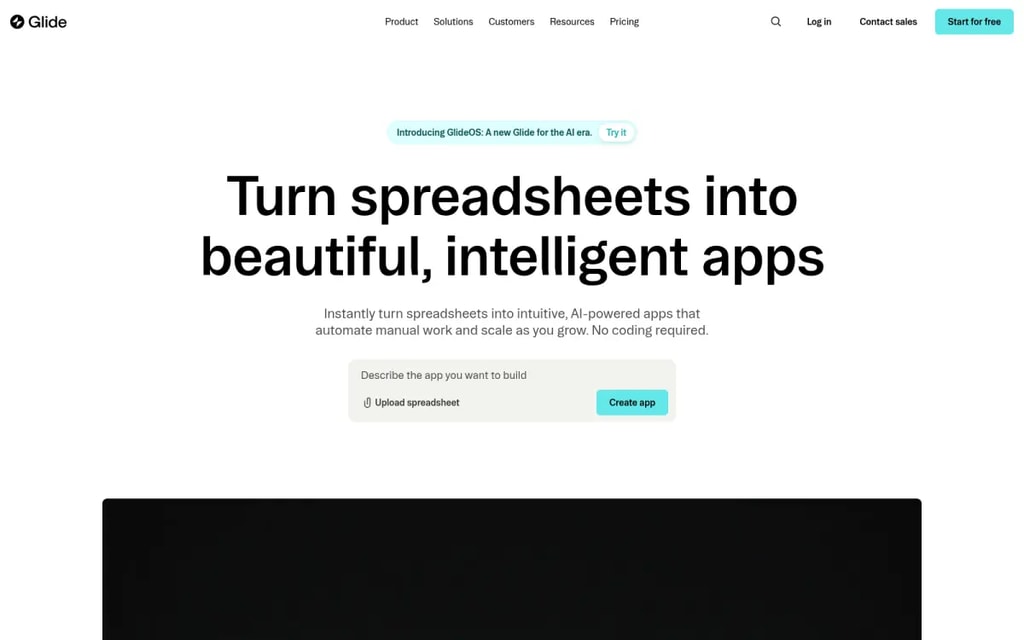
Glide is what I'd recommend to most people leaving Softr for portal or internal-tool use cases. It turns spreadsheets and databases into polished apps, and the output simply looks better than Softr's. The design system is opinionated in a good way: it's hard to build something ugly.
What it does better than Softr: the apps feel native and fast, the free tier is generous (up to 25,000 rows), and entry pricing is lower. Glide's plans start at $10/month for Explorer and $35/month for Maker with unlimited personal users. Workflows and AI features are built in.
What it does worse: the jump to Business is steep at $199/month (billed annually), and that's where the serious features live: API access, 30+ users for company use cases, express support. Glide is also app-first, so it's weaker than Softr for anything resembling a public website.
Who should pick it: anyone building a client portal, field-team app, or internal tool who wants it to look professional without design effort.
Pro tip: a quick note on Stacker, which used to be the default Softr alternative in this category. It has pivoted entirely to AI agents (it's now stacker.ai, selling agent plans instead of portal software). Don't follow old listicles recommending it for client portals; that product effectively no longer exists.
2. Noloco
Noloco is the closest like-for-like Softr replacement. It builds client portals and internal tools on top of Airtable, SmartSuite, or SQL databases, with noticeably deeper permission controls than Softr offers at comparable tiers.
What it does better than Softr: record-level and field-level permissions on the Pro plan, unlimited apps on every tier, and a more generous client-seat model. Noloco's pricing runs $149/month for Pro ($99 on annual) with 10 team seats and 50 client seats, plus $1 per extra client seat. If you charge clients for portal access, that math works out much better than Softr's user limits.
What it does worse: it's a smaller company with a smaller template library and community. The free tier (3 team seats, 2,000 rows) is tighter than Glide's. And the entry price is higher than both Softr and Glide, so it only makes sense when you actually need the permission depth.
Who should pick it: agencies and service businesses running client portals on Airtable data who keep hitting Softr's permission and user-group walls.
3. Airtable Interfaces
Here's the uncomfortable question for Softr: if your data lives in Airtable, why pay a second subscription to put a face on it? Airtable's own Interface Designer has matured to the point where it covers a big chunk of what people used Softr for.
What it does better than Softr: zero sync issues (it IS the database), no separate tool to maintain, and it's included in Airtable's plans. The Team plan is $20/user/month billed annually, and read-only collaborators don't cost anything.
What it does worse: interfaces are for your team and collaborators, not really for external customers at scale. Design flexibility is limited, there's no custom domain for a public-facing app, and per-seat pricing gets painful if many people need edit access.
Who should pick it: teams already paying for Airtable who need dashboards and internal tools, not a customer-facing product.
Best for Websites and Directories
Softr markets itself as a website builder too. This is where I think it's weakest, and where I have the strongest opinions, since directories are my actual business.
4. Webflow
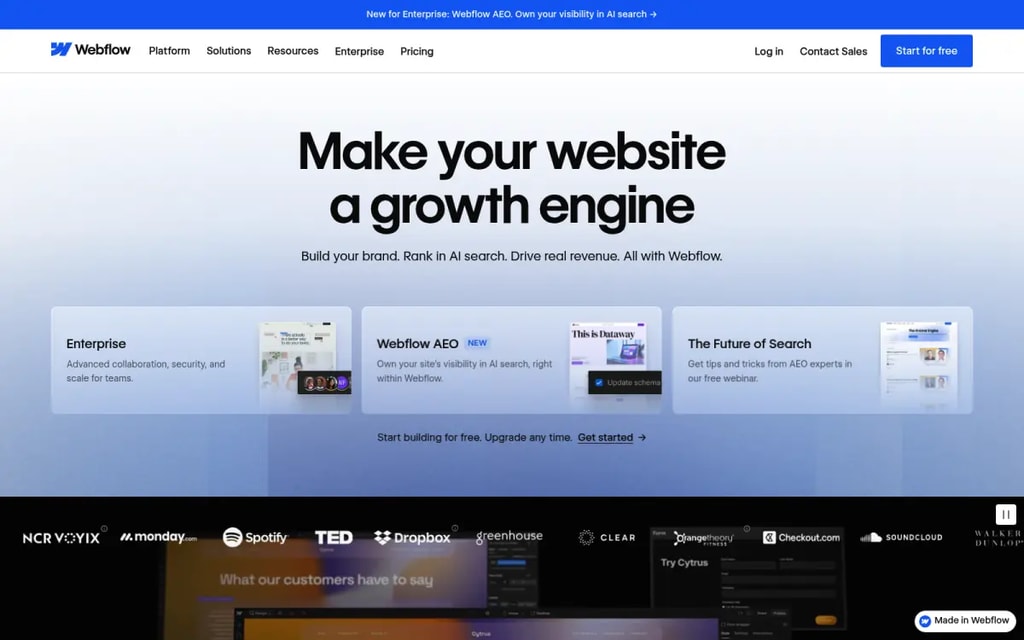
For marketing sites and landing pages, Webflow isn't just better than Softr, it's in a different league. Full visual control over every element, a proper CMS, and clean code output instead of block-based layouts that all look the same.
What it does better than Softr: design freedom, SEO fundamentals (clean markup, fast pages, full meta control), and CMS capacity. Webflow's site plans start at $15/month for Basic and $25/month for the CMS-enabled Premium plan (billed annually), which handles up to 20,000 CMS items. You can also export static code, something Softr can't do at all.
What it does worse: the learning curve is real. Webflow is a professional design tool, and if you've never thought in terms of the box model, expect a frustrating first week. It also has no concept of app users or logged-in portals without bolting on third-party tools.
Who should pick it: anyone whose "Softr website" is actually a marketing site, blog, or content-driven brochure. For directories it can work at small scale, but CMS item limits and the lack of user accounts cap how far you can take it.
5. WordPress
I built Chipmunk, a WordPress directory theme, before I ever wrote a line of Dirstarter, so I'll defend WordPress against the no-code crowd any day. It powers a huge share of the web for a reason: it's free, infinitely extensible, and you own everything.
What it does better than Softr: total ownership, no per-user pricing, a plugin for literally everything, and proven SEO at any scale. Your real cost is hosting, typically $5-30/month, and your data is yours forever.
What it does worse: maintenance. Updates, security, plugin conflicts, performance tuning: it's all on you. The editing experience is also clunkier than any modern no-code tool, and a good directory setup requires picking the right theme and plugins carefully. If you go this route, my guide to directory websites applies regardless of stack.
Who should pick it: budget-conscious builders who want ownership without writing code from scratch, and anyone whose site needs to live for years without a SaaS dependency.
6. Dirstarter
Full disclosure before anything else: this is my product, so read this section with that in mind.
Dirstarter is a Next.js boilerplate built specifically for directory websites. It exists because I built OpenAlternative (the full case study is here) and kept rebuilding the same stack: listings, categories, submissions, payments, programmatic SEO pages, admin panel. Dirstarter is that stack, packaged.
What it does better than Softr: the economics and the ceiling. It's a one-time payment of around $149 instead of $49-139 every single month. You get the full source code, so there's no platform risk, no record limits, and no SEO compromises: you control every URL, meta tag, and page template, which is exactly what made OpenAlternative's organic growth to 70,000 monthly visitors possible. Stripe payments for paid and featured listings work out of the box.
What it does worse: it's code. You need to be comfortable deploying a Next.js app and editing TypeScript, or willing to let an AI coding assistant do most of it. If you've never touched a terminal and don't want to, Softr's drag-and-drop will genuinely feel easier. It's also directory-specific: it won't build your client portal.
Who should pick it: anyone treating a directory as a business rather than a side widget. You can see what people have shipped with it in the showcase, and my guide on how to start an online directory business covers the strategy side.
Best for Full Web Apps
7. Bubble
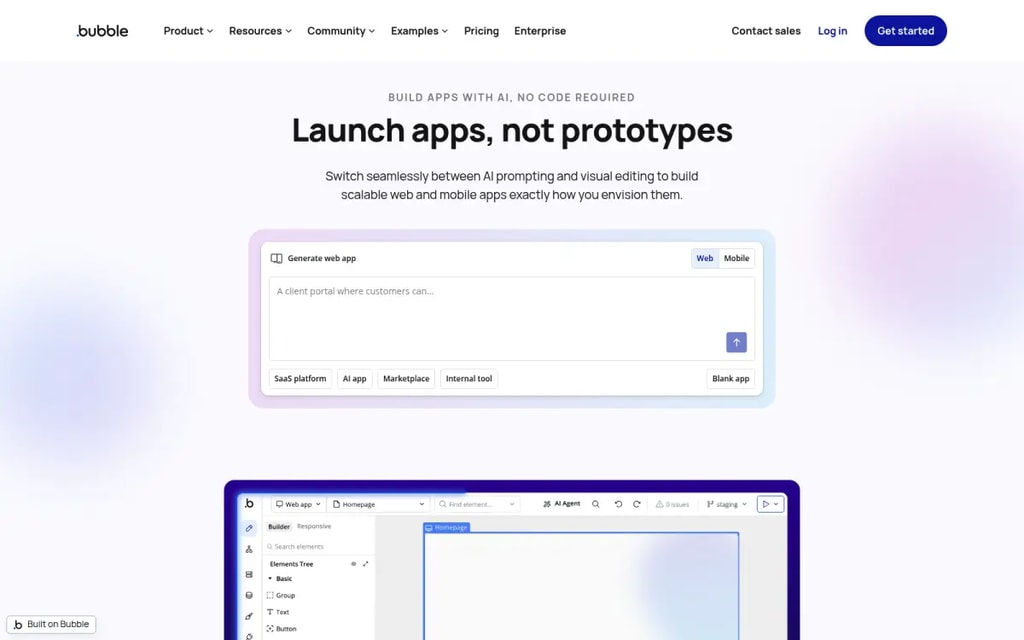
When people outgrow Softr because they need real application logic (multi-step workflows, complex data relationships, marketplace mechanics), Bubble is usually where they land. It's the most powerful no-code app builder, full stop.
What it does better than Softr: almost unlimited logic. Custom workflows, a real database, API connections to anything, plugins, and now native mobile builds. If you can diagram it, you can probably build it in Bubble.
What it does worse: complexity and cost predictability. The learning curve is measured in weeks. Bubble's plans start at $29/month (Starter, annual billing) and $119/month for Growth, but the catch is workload units: every action your app performs consumes them, and agencies that build on Bubble professionally report real monthly costs often landing in the hundreds once overages and plugins stack up. And like Softr, there's no code export, so you're locked in.
Who should pick it: founders building an actual product (SaaS, marketplace, booking platform) who would otherwise need to hire developers. Not people who need a portal or a website; that's paying for power you won't use.
How to Choose
Strip away the feature lists and the decision is simple:
- Client portal or internal tool? Glide for polish and price, Noloco for permission depth, Airtable Interfaces if you're already paying for Airtable.
- Marketing website? Webflow if design matters and you'll invest the learning time, WordPress if budget and ownership matter more.
- Directory business? WordPress for the cheapest start, Dirstarter for full code ownership and a one-time price. I compared the code-based options in the best directory boilerplates.
- Real web app? Bubble, and budget for the learning curve.
Pro tip: whatever you pick, run the 24-month math before committing. Softr Professional costs $3,336 over two years. Glide Business is $4,776. A one-time boilerplate plus free-tier hosting is a few hundred dollars total. Subscriptions feel cheap monthly and expensive in hindsight.
Final Thoughts
The best Softr alternatives aren't one tool, they're one tool per job. Softr's pitch is that it does everything; the reality I keep seeing is that specialists win on every axis that matters, whether that's Glide's polish, Webflow's design control, Bubble's logic, or owning your code outright.
My honest take after a decade of building directories: if your project is a business asset, bias toward ownership. Platforms change pricing, pivot (ask Stacker users), or shut down. Code you own does none of those things.
And if that business asset happens to be a directory, you know where I stand. Check the Softr review if you're still weighing it, or start with the directory business guide and pick your stack from there.