These directory website statistics pull together public, verifiable data on how directories make money and how people use them. The short version: the biggest directories are billion-dollar businesses, indie directories make anywhere from a few thousand dollars a month to several hundred thousand a year, and consumers still lean heavily on reviews and listings to choose a business.
I run OpenAlternative and build Dirstarter, a directory boilerplate, so I have an interest in this topic. That's also why I wanted a page built from public filings, published surveys and real rate cards, and not from one platform's internal numbers. Every figure below links to the source I checked in October 2026. Where a number is mine, I say so.
Big directories and marketplaces
The largest directories are public companies, which means their numbers come from audited filings. They all run the same basic model: list a lot of businesses, attract searchers, then sell visibility to the businesses.
| Company | Statistic | Source |
|---|---|---|
| Yelp | $1.46 billion net revenue in 2025, up 4% | Yelp Q4 2025 release |
| Yelp | $948 million services advertising revenue in 2025, up 8% | Yelp Q4 2025 release |
| Yelp | 330 million cumulative reviews, 22 million added in 2025 | Yelp Q4 2025 release |
| Yelp | Ad clicks down 7% in 2025, average cost per click up 10% | Yelp Q4 2025 release |
| Tripadvisor | $1,891 million revenue in 2025, up 3% | Tripadvisor Q4 2025 release (SEC) |
| Tripadvisor | More than one billion reviews and opinions | Tripadvisor 2025 10-K |
| Zillow | $2.6 billion revenue in 2025, up 16% | Zillow Q4 2025 release |
| Zillow | 221 million average monthly unique users in Q4 2025 | Zillow Q4 2025 release |
| Zillow | About 9.6 billion visits in 2025 | Zillow 2025 10-K |
| Zillow | 2.4 million average monthly active rental listings | Zillow 2025 10-K |
| Angi | $1,030.5 million revenue in 2025, down 13% | Angi Q4 2025 release (SEC) |
| Angi | 3.48 million service requests and 111,000 average monthly active pros in Q4 2025 | Angi Q4 2025 release (SEC) |
| G2 | 3 million+ reviews, 200,000+ products, 2,000+ categories | G2 2025 year in review |
| G2 | Reached 100 million+ buyers in 2025 | G2 2025 year in review |
| G2 + Capterra, Software Advice, GetApp | Agreed acquisition in January 2026: combined 200 million+ annual buyers, nearly 6 million reviews | G2 announcement |
| Clutch | 350,000+ service providers across 2,000+ categories | Clutch homepage |
Yelp's click volume fell while its price per click rose, and revenue still grew. G2 buying Capterra, Software Advice and GetApp from Gartner puts four of the biggest software directories under one owner.
What this means for directory builders: listing businesses and selling visibility to them is a proven model at the billion-dollar scale. Yelp's numbers show that businesses keep paying more per click when the traffic is high intent, which is the same dynamic a niche directory can use.
Indie directory revenue
Most directories are not public companies, so verified numbers are rare. These are the ones I can back with a first-hand number or a published source.
| Directory | Revenue | Source |
|---|---|---|
| OpenAlternative | About $6,500/month (about $80,000/year) | My own numbers (case study) |
| Nomad List | About $360,000/year | Founder-reported public figure |
| SaaSHub | About $120,000/year | Founder-reported public figure |
| Japan Dev (job board) | $62,197 in July 2022, after a first year with zero revenue | Founder's write-up |
| BetaList | Almost $1 million lifetime revenue over 10 years | Marc Köhlbrugge's retrospective |
| Sober Nation | Over $250,000/year in profit | Partnerkin case study |
More detail on OpenAlternative, where I have the full picture:
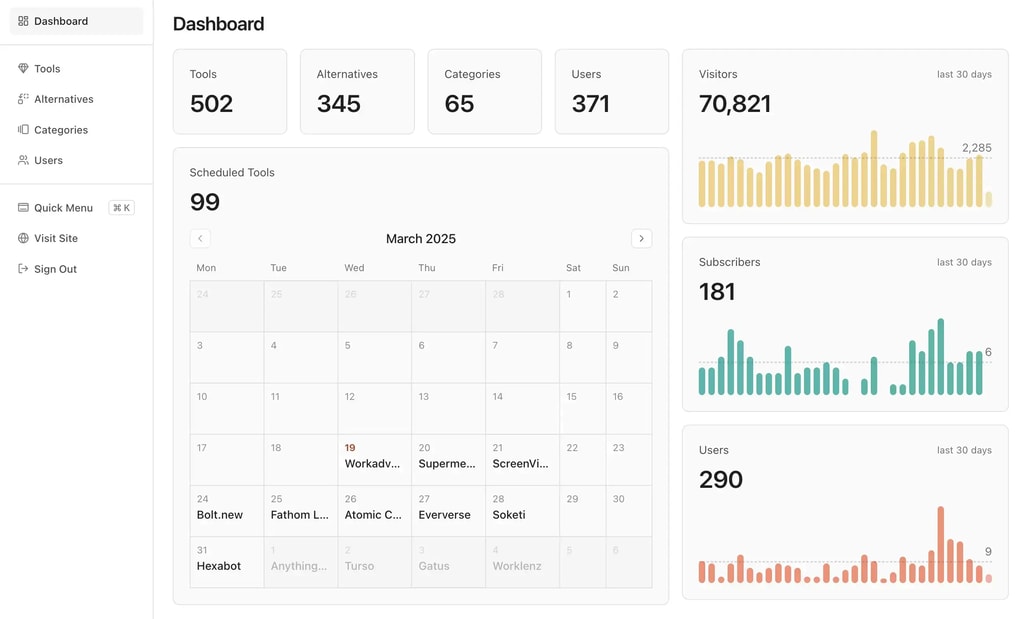
- About 200,000 monthly visitors
- About 65% of revenue from ads and sponsorships
- Featured listings at $197/month, about 35% of revenue
- First version built in 48 hours, about 1 year to meaningful revenue
- 2-3 hours/week of maintenance today
$6,500 a month from 200,000 visitors works out to about $0.03 per visitor per month. Japan Dev is the other useful data point: it earned nothing for 12 months and then passed $60,000 a month with a two-person team, using a success fee charged when a company hires through the board.
What this means for directory builders: a solo or two-person directory can realistically reach $80,000-360,000 a year, but none of these sites got there quickly. Plan for a year of building traffic before revenue is meaningful. I wrote up the longer version in how much directory websites make.
Local search and review behavior
Local business directories depend on one habit: people looking up businesses online and checking reviews before they buy. BrightLocal runs the most widely cited annual survey on this, and its 2026 edition shows the habit is getting stronger.
From the Local Consumer Review Survey 2026 (1,002 US adults, published February 11, 2026):
- About 97% of consumers read reviews for local businesses.
- 41% "always" read reviews, up from 29% in 2025.
- 68% will only use a business with four stars or more, up from 55%.
- 31% will only use a business with 4.5 stars or more, up from 17%.
- 47% won't use a business with fewer than 20 reviews.
- 74% look for reviews written in the last three months.
- The average consumer uses six review sites when choosing a business.
- 71% use Google for reviews (down from 83%), and Apple Maps rose from 14% to 27%.
- Use of ChatGPT and other AI tools for local recommendations rose from 6% to 45%.
- 24% of consumers write reviews on Yelp, and 16% on Tripadvisor.
From BrightLocal's local search channels study (1,227 US consumers, published July 9, 2026):
- BrightLocal reports that 84% of consumers searched for a local business online in the previous three months.
- 52% started their most recent local search on Google Search, 9% on Google Maps and 9% on social media.
- 75% used more than one channel during the search.
- 19% used review sites at some point, and 23% used AI tools.
- 73% started the search on a mobile device.
What this means for directory builders: consumers check several sources before they choose a business, so a focused directory with recent, detailed reviews has room to win. The shift toward AI tools means your listings also need clean, structured data that AI assistants can read. I cover the local angle in how to start a local business directory.
Job board pricing
Job boards are directories of jobs, and their pricing is unusually transparent because employers buy posts through public checkout pages. These prices come from each board's own posting page.
| Job board | Published price | Source |
|---|---|---|
| RemoteOK | Starting at $299 per post, live for 30 days | RemoteOK post a job |
| RemoteOK | Talent marketplace access at $249/year | RemoteOK post a job |
| RemoteJobs.org | $149 for a 30-day standard post, $299 featured | RemoteJobs.org post a job |
| ProBlogger | Job posts from $80 | ProBlogger post a job |
| Japan Dev | Success fee charged when a company hires, no flat posting fee | Founder's write-up |
RemoteOK also sells bundles at up to 50% off per post, plus paid boosts (highlight, pin, email blast).
What this means for directory builders: $149-299 for a 30-day post is the going rate on established remote boards, with featured upgrades on top. A niche board with a smaller, more qualified audience can start lower and raise prices as traffic grows. My niche job board guide covers the full playbook.
Advertising and sponsorship rates on directories
Most directories make their real money from businesses paying to stand out. These are rate cards published on the directories' own pages.
| Directory | Product | Price | Source |
|---|---|---|---|
| SaaSHub | Featured listing | $99/month | SaaSHub featured products |
| OpenAlternative | Featured listing | $197/month | My own pricing |
| BetaList | Boost (featured startup) | From $99/week or $199/month | BetaList advertise |
| BetaList | Sponsorship (one sponsor at a time) | $4,999/month | BetaList advertise |
| BetaList | Premium (homepage, newsletter, dedicated email) | $9,999/month, or $25,000 for three months | BetaList advertise |
| BetaList | Expedited review | $199 (started at $15) | Marc Köhlbrugge's retrospective |
The audience claims on those pages give some context for the prices. SaaSHub reports 564,000+ monthly visits and 31,300+ newsletter subscribers. BetaList reports 70,000+ newsletter subscribers and 500,000+ monthly pageviews.
BetaList's history is the most useful lesson here. Marc started ad slots at $50 a week and kept doubling the price until advertisers said no, and they reached $1,500 a week. Today the top package is $9,999 a month.
What this means for directory builders: featured listings in the $99-199/month range are standard for software directories. Monthly sponsorship prices scale with traffic and newsletter size. When in doubt, copy Marc's approach and raise prices until someone says no. The directory revenue models guide explains how to stack these.
SEO and structured data
Directories live on search traffic, and most of their pages are generated from a database. I've limited this section to Google's own documentation, because most published SEO numbers are hard to verify.
From Google's introduction to structured data:
- Rotten Tomatoes added structured data to 100,000 pages and measured a 25% higher click-through rate on those pages.
- Food Network converted 80% of its pages to enable search features and saw a 35% increase in visits.
- Nestlé measured an 82% higher click-through rate on pages shown as rich results.
- Rakuten found users spent 1.5x more time on pages with structured data.
From Google's documentation on sitemaps and crawl budget:
- A single sitemap is limited to 50,000 URLs or 50MB uncompressed. Larger sites need multiple sitemaps, optionally grouped in a sitemap index.
- Google's crawl budget guide is aimed at sites with 1 million+ unique pages that change weekly, or 10,000+ unique pages that change daily. Google calls these rough estimates.
What this means for directory builders: structured data on listing pages is one of the few SEO tactics with published, measured results. Most new directories sit well below the crawl budget thresholds, so the work is page quality and structured data, not crawl tuning. Dirstarter ships with structured data and sitemaps built in (SEO docs), and I go deeper in programmatic SEO for directory websites.
How to cite these statistics
You're welcome to use any number on this page. Please use this attribution line and link:
Source: Dirstarter, "Directory Website Statistics 2026" (https://dirstarter.com/blog/directory-website-statistics)
If your publication prefers primary sources, every statistic above links to the filing, survey or pricing page it came from. Cite that source directly and, if you can, link this page as the place you found it.
Methodology
I built this page from four kinds of sources:
- Company filings and investor releases for public directories (Yelp, Tripadvisor, Zillow, Angi), taken from investor relations sites and SEC EDGAR.
- Official company pages for private platforms (G2, Clutch) and published rate cards (SaaSHub, BetaList, RemoteOK, RemoteJobs.org, ProBlogger).
- Published surveys from BrightLocal, with the sample size and date listed next to each.
- Founder-reported numbers for indie directories, including my own figures for OpenAlternative.
I left out estimates from traffic tools and third-party revenue trackers, because I can't verify them. Company-reported audience figures (visitors, subscribers) are the companies' own claims. All sources were checked in October 2026, and I refresh the page quarterly. If a number has changed or a link breaks, let me know and I'll update it.
These directory website statistics point the same way at every scale: people use directories to choose what to buy, and businesses pay to be visible there. If you want to build one, Dirstarter gives you the full stack (listings, featured tiers, ads, structured data) for a one-time payment.